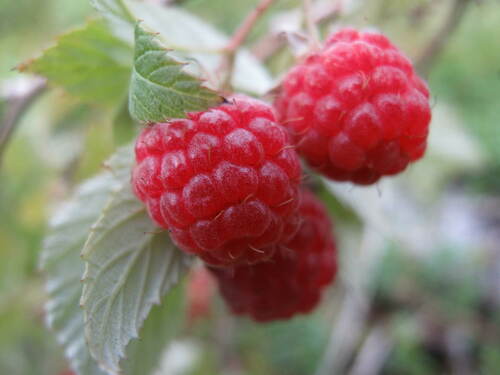
red raspberry
Rubus idaeus
A crown jewel of the backyard garden, the Red Raspberry is a powerhouse of nutrition for both humans and wildlife. Its thorny thickets provide a safe haven for nesting birds while offering a summer feast of sweet, sun-ripened berries.
Quick Identification
Size
Canes typically reach 1.5–2.5 meters (5–8 feet) in height with a spread of 0.6–1.2 meters (2–4 feet).
Colors
Vibrant red fruit; white five-petaled flowers; medium green leaves with distinct silvery-white undersides.
Key Features
- Arching canes covered in small, needle-like prickles
- Hollow fruit (the core stays on the plant when picked)
- Compound leaves with 3 to 5 serrated, oval leaflets
- Greenish-white flower buds that open into drooping white blossoms
When You’ll See Them
Behavior
Red raspberries are hardy perennials that utilize a biennial cane system. The first-year canes, known as primocanes, focus on vegetative growth and rarely produce fruit. In their second year, these canes become floricanes, developing lateral branches that produce flowers and the iconic red berries before the cane eventually dies back. This cycle ensures a thick, self-sustaining patch that expands via underground runners called rhizomes.
In a backyard ecosystem, the red raspberry acts as a high-traffic hub for biodiversity. In early summer, the nectar-heavy flowers are a primary fuel source for native bees and butterflies. As the fruit ripens, the plant becomes a competitive feeding ground for songbirds and small mammals. Because the canes grow in dense, thorny tangles, they also provide excellent protective cover for ground-nesting birds and small reptiles seeking refuge from predators.
EverydayEarth exclusive
Camera Tips
To capture the best images of red raspberry, focus on its role as a natural 'stage' for wildlife. Instead of just photographing the plant, treat a cluster of ripening berries as a lure for a variety of birds and insects. Position your AI-powered camera 2 to 3 feet away from a cluster of berries that is beginning to turn from pink to red. Use a 'landscape' orientation to capture birds landing on the arching canes, or a 'portrait' orientation if you want to focus on the intricate details of the fruit and visiting pollinators like bumblebees.
Since raspberry leaves are often light-sensitive and move in the breeze, avoid placing your camera where it will be triggered by wind-blown foliage. Secure the specific cane you are monitoring to a small bamboo stake to keep it perfectly still within your camera's focal plane. If your camera has a macro setting, use it to highlight the 'drupelets' (the tiny individual bumps on the berry) and the fine, protective hairs on the stems, which look spectacular in the low-angled light of early morning.
For high-quality wildlife interaction shots, time is everything. Most birds, like Gray Catbirds and Northern Cardinals, will visit the patch at dawn to get the first pick of the ripe fruit. Set your camera to a 'Burst Mode' or high-frame-rate video to catch the fast action of a bird plucking a berry. In the evening, lower your camera angle to roughly 10 inches off the ground; this is the perfect height to catch nocturnal visitors like raccoons or opossums that might scavenge fallen berries from the garden floor.
Finally, consider the background. Red berries pop beautifully against a blurred green backdrop. If your raspberry patch is against a fence or wall, try to angle the camera so there is depth behind the plant. This 'bokeh' effect will make your AI detections much cleaner and the resulting photos look like they belong in a nature magazine. If you are using a camera with a solar panel, ensure the panel is positioned above the raspberry canopy, as the broad leaves can quickly grow to shade out your power source during the peak of summer.
Similar Species
Species that look similar or are commonly confused with red raspberry.
Frequently Asked Questions
Record red raspberry at your habitat
Connect a camera to start building your own species record — AI identifies every visitor automatically.