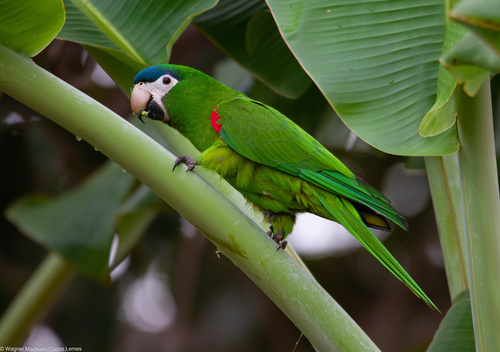
Red-shouldered Macaw
Diopsittaca nobilis
Meet the world's smallest macaw: a pint-sized powerhouse of green feathers and fiery red accents. The Red-shouldered Macaw brings all the charisma of the rainforest right into the suburban backyard.
Quick Identification
Size
30 cm (12 in) in length; weighs approximately 130-170 g (4.6-6 oz)
Colors
Mainly bright green plumage with distinctive red feathers on the bend of the wing (the shoulders) and underwing coverts; white bare skin patch around the eyes; dark grey to horn-colored beak.
Key Features
- Bright red 'shoulder' patches on the wing bend
- Smallest macaw species in the world
- Large white featherless patch surrounding the eye
- Pointed tail and slender, parakeet-like silhouette
When You’ll See Them
Geographic range
Where Does the Red-shouldered Macaw Live?
The Red-shouldered Macaw is native to the tropical lowlands of South America, residing primarily east of the Andes. Its core territory stretches across northern and central Brazil, the Guianas, Venezuela, and eastern Bolivia, with populations also found in southeastern Peru. Because they are popular in the pet trade, small naturalized populations have occasionally been reported in urban areas outside their native range, though they remain most abundant in their original tropical habitats.
Basemap © OpenStreetMap contributors
Behavior
The Red-shouldered Macaw is an exceptionally social and high-energy bird. Often found in pairs or small, boisterous flocks, they spend much of their day foraging in the canopy or flying between feeding sites. They are known for being extremely vocal, maintaining constant communication with their group through a series of loud, rasping screeches that can be heard from a significant distance.
In the wild, they are cautious but curious, often investigating new food sources or potential nesting sites in hollow trees or palm snags. When interacting with humans in suburban environments, they can become quite bold, especially if a reliable food source like a bird feeder or a fruiting garden is present. Their intelligence is evident in their complex social play and their ability to solve puzzles to reach food.
EverydayEarth exclusive
Camera Tips
To successfully capture a Red-shouldered Macaw on camera, height is your best friend. These birds prefer to stay in the upper strata of trees, so mounting your AI-powered camera 10 to 15 feet high on a sturdy branch or a specialized pole will yield the best results. If you are using a backyard setup, position the camera to overlook a high-platform feeder or a tall birdbath, as they are cautious about descending to ground level.
Lighting is crucial for capturing the vibrant greens and the signature red 'shoulders.' Try to angle your camera with the morning sun behind it to illuminate the bird's plumage as they arrive for their first feed of the day. Using a fast trigger speed or high-frame-rate video is highly recommended, as these macaws move quickly and are prone to sudden, erratic flights when startled or excited.
If you live in a region where they are common, baiting with large sunflower seeds, walnuts, or tropical fruits like mango and papaya can keep them in the camera's field of view for longer periods. During the drier months, a dripping water feature at an elevated position is an almost irresistible lure. Set your camera for 'burst mode' to capture the social interactions between pairs, which often involve mutual preening or playful beak-sparring.
Similar Species
Species that look similar or are commonly confused with Red-shouldered Macaw.
Frequently Asked Questions
Record Red-shouldered Macaw at your habitat
Connect a camera to start building your own species record — AI identifies every visitor automatically.