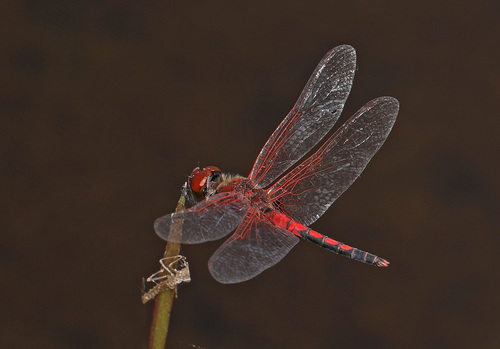
Red-veined Pennant
Celithemis bertha
A jewel of the Southern wetlands, the Red-veined Pennant dazzles with its crimson-laced wings and characteristic 'flag-like' perching habit.
Quick Identification
Size
A small dragonfly with a length of 28–32 mm (1.1–1.3 inches) and a wingspan of approximately 45–55 mm (1.8–2.2 inches).
Colors
Adult males are striking with bright red veins at the base of their wings and red heart-shaped spots on a dark abdomen. Females and juveniles are primarily yellow and brown.
Key Features
- Bright red or orange wing venation at the base of the hindwings
- Heart-shaped red or yellow spots along the top of the abdomen
- Characteristically perches on the tips of vegetation with wings pushed forward
- Small, delicate build with a dark face
When You’ll See Them
Geographic range
Where Does the Red-veined Pennant Live?
Native to the North American continent, the Red-veined Pennant is a signature species of the Southeastern United States. Its core range is concentrated along the Atlantic and Gulf Coastal Plains, stretching from North Carolina down through the entirety of Florida and westward into Louisiana. While it is most abundant in these coastal regions, localized populations can be found around specific acidic wetland habitats slightly further inland, though it remains a specialist of the warm, humid southern lowlands.
Basemap © OpenStreetMap contributors
Behavior
The Red-veined Pennant is a classic "percher" dragonfly, earning its name from the way it sits on the very tips of tall grasses or aquatic plants, waving in the breeze like a tiny flag or pennant. Unlike some larger dragonfly species that spend most of their day on the wing, this species prefers to sit and wait for prey to fly by. They are highly territorial, with males guarding small patches of shoreline or pond edges, frequently darting out to chase off rivals or snag a meal before returning to the exact same perch.
These dragonflies are known for their unique resting posture; when perched, they often hold their wings forward and downward, which is thought to help with thermoregulation or as a stabilization technique in windy environments. They are relatively docile compared to larger skimmers and can often be approached quite closely by observers, making them a favorite for backyard naturalists and macro photographers.
EverydayEarth exclusive
Camera Tips
To capture the Red-veined Pennant on camera, placement is everything. These dragonflies are creatures of habit and will return to the same tall reed or twig repeatedly. Look for vertical stalks that stand taller than the surrounding vegetation near a water source. Position your camera on a tripod or mount at the same height as the tip of the stalk, ideally about 3 to 5 feet off the ground. Because they are small, a macro lens or a camera with a strong digital zoom is essential for capturing the intricate red venation in their wings.
Lighting is your best friend when filming this species. Try to angle your camera so the sun is behind the dragonfly or slightly to the side; this backlighting causes the red veins in the wings to glow, making for a much more dramatic image. Since they are most active during the hottest part of the day, midday sun is actually beneficial here, though the "golden hour" shortly before sunset can produce beautiful reflections on the water in the background.
If you are using an AI-powered backyard camera, set it to a high-speed capture mode. Dragonflies move with incredible speed, and even while perched, their wings may flutter. A shutter speed of at least 1/1000th of a second is recommended to freeze the motion of the wings. You don't need bait for these insects, but providing a "perfect perch"—a solitary, stiff bamboo stake or a dry branch placed near the water's edge—will often entice them to land exactly where your camera is focused.
Similar Species
Species that look similar or are commonly confused with Red-veined Pennant.
Frequently Asked Questions
Record Red-veined Pennant at your habitat
Connect a camera to start building your own species record — AI identifies every visitor automatically.