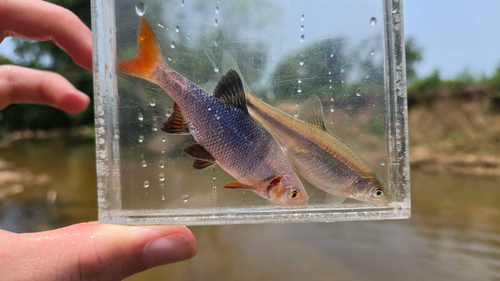
Redfin Shiner
Lythrurus umbratilis
A hidden gem of the creek, the Redfin Shiner transforms from a humble silver minnow into a fiery crimson spectacle during the summer months. These social swimmers turn ordinary stream pools into vibrant underwater festivals.
Quick Identification
Size
Typically 5-8 cm (2-3 inches) in length
Colors
Silvery-blue body with a prominent dark spot at the base of the dorsal fin. Breeding males develop fiery red or orange fins and a rosy flush across their heads and bodies.
Key Features
- Dark spot at the front base of the dorsal fin
- Breeding males display vibrant red fins and blue-silver bodies
- Slender, side-compressed body shape
- Small white 'tubercles' or bumps on the heads of males during spawning
When You’ll See Them
Behavior
The Redfin Shiner is a social, schooling fish that brings a surprising burst of color to North American streams. Unlike many other minnows that blend into the background, these fish are famous for their high-energy displays during the summer months. They are 'nest associates,' meaning they frequently gather around the nests of larger fish like Green Sunfish or Longear Sunfish to deposit their own eggs, benefiting from the protection of the larger fish.
In the water, they are incredibly active and fast-moving. While they aren't traditionally 'tame,' they are relatively bold for small fish and will often hover in mid-water columns where the current is slow. Because they are social, seeing one Redfin Shiner usually means there are dozens more nearby, darting through the shadows and sunlight of the creek bed.
EverydayEarth exclusive
Camera Tips
To capture the Redfin Shiner on camera, you need to think like an underwater cinematographer. Since these fish are small and fast, a submersible action camera (like a GoPro or a dedicated underwater trail cam) is your best bet. Place the camera in shallow, clear pools—ideally near a submerged log or a sunfish nest during the summer. Use a weighted mount to keep the camera steady on the stream bed, angling it slightly upward toward the water surface to catch the light glinting off their scales.
Lighting is the most critical factor for this species. Try to set your camera during the brightest part of the day when the sun can penetrate the water column; this is the only way to truly capture the brilliant reds and blues of the breeding males. If you are filming from above the water, a circular polarizing filter is mandatory to cut through the surface reflection and see into the creek.
For settings, use a high frame rate (at least 60fps). These fish move in quick, jerky bursts, and standard frame rates will often result in a blurry silver streak. A high shutter speed will help freeze the motion of their fins. Because they are curious, you don't necessarily need bait, but stirring up a small amount of sediment or 'kicking' a few rocks upstream can release natural larvae that will draw the school right in front of your lens.
Similar Species
Species that look similar or are commonly confused with Redfin Shiner.
Frequently Asked Questions
Record Redfin Shiner at your habitat
Connect a camera to start building your own species record — AI identifies every visitor automatically.