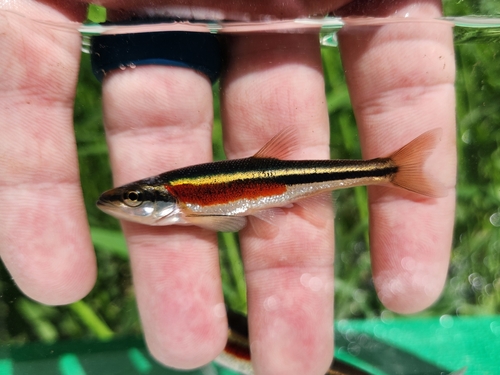
Redside Dace
Clinostomus elongatus
A vibrant 'living jewel' of our freshwater systems, the Redside Dace is famous for its acrobatic leaps and brilliant crimson colors. Spotting one is a sure sign of a healthy, pristine stream.
Quick Identification
Size
Typically 7.5 to 10 cm (3 to 4 inches) in length, with a maximum size of 12 cm (4.7 inches).
Colors
Silver-blue body with a prominent, vibrant red lateral stripe that intensifies in males during spring; a distinct yellow or gold stripe runs parallel just above the red band.
Key Features
- Exceptionally large, upturned mouth with a protruding lower jaw
- Brilliant crimson-red stripe along the sides
- Bright yellow-gold stripe above the red
- Slender, streamlined body with small scales
When You’ll See Them
Geographic range
Where Does the Redside Dace Live?
Native to the temperate freshwater regions of North America, the Redside Dace is primarily concentrated within the Great Lakes basin and the upper Mississippi River drainage. Its core populations are found in the northeastern United States, spanning from New York and Pennsylvania to Minnesota, with significant but fragmented populations in Southern Ontario, Canada. Because of their strict requirement for clear, cool water, they are often restricted to isolated pockets of high-quality habitat within these regions.
Basemap © OpenStreetMap contributors
Behavior
The Redside Dace is a remarkable aerialist of the stream world, known for its unique 'surface-snatching' feeding style. Unlike many other minnows that forage along the bottom, this species specialized in hunting terrestrial insects. It often hovers just below the surface, using its large, upward-turned mouth to leap several centimeters out of the water to catch flies and midges mid-air. This high-energy lifestyle requires clean, oxygen-rich water and excellent visibility.
These fish are highly social and are often found in small schools within clear pools. They are also known as 'nest associates,' a fascinating behavior where they congregate to lay their eggs in the gravel nests built by larger fish species, such as Creek Chubs. This symbiotic relationship provides the dace eggs with protection and aeration. Because they are extremely sensitive to silt and pollution, their presence is a gold-standard indicator of a healthy, pristine aquatic ecosystem.
EverydayEarth exclusive
Camera Tips
Capturing the Redside Dace requires an underwater perspective, as their vibrant colors are best viewed from the side rather than looking down through the surface ripple. Use a waterproof action camera with AI-motion detection mounted on a weighted base or a low-profile underwater tripod. Position the camera in a slow-moving pool directly beneath overhanging grass or shrubs, as this is where the fish wait for terrestrial insects to drop into the water.
To capture their famous jumping behavior, angle the camera slightly upward toward the water's surface. High frame rate settings (60 FPS or 120 FPS) are essential; the leap of a Redside Dace happens in a fraction of a second, and standard frame rates will often result in a blur. Ensure your camera is placed in an area with dappled sunlight, as the natural light will catch the iridescent yellow and red stripes, making them pop against the darker stream background.
Because these fish are sensitive to habitat changes, avoid disturbing the stream bed more than necessary. Place your camera and then retreat from the bank for at least 20-30 minutes to allow the school to settle back into their natural rhythm. The best time for filming is during the late spring spawning season (May and June) when the males are at their most colorful and are actively congregating around Creek Chub nests in shallower, gravel-bottomed areas.
If you are filming from above the water, a high-quality circular polarizer filter is mandatory to cut through surface reflections. Look for 'shiners'—the quick silver flashes of the fish turning—to identify the best spots for placement. Remember that clear water is a prerequisite for this species, so avoid filming immediately after heavy rains when the water may be turbid.
Similar Species
Species that look similar or are commonly confused with Redside Dace.
Frequently Asked Questions
Record Redside Dace at your habitat
Connect a camera to start building your own species record — AI identifies every visitor automatically.