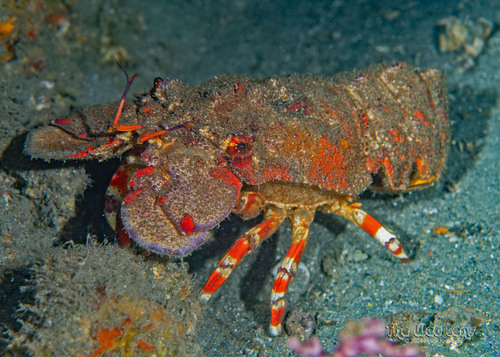
Ridged Slipper Lobster
Scyllarides nodifer
The ultimate master of marine disguise, the Ridged Slipper Lobster swaps flashy claws for a heavy-duty, armored shell and shovel-shaped antennae. Watching these 'bulldozers of the reef' emerge at night offers a rare glimpse into the hidden world of the Atlantic seafloor.
Quick Identification
Size
Typically 20-30 cm (8-12 inches) in length; weighs approximately 0.5-1.5 kg (1-3 lbs)
Colors
Mottled rusty brown, tan, and gray carapace; legs and underside often feature subtle purple or reddish spots; lacks the bright colors of some reef species to maintain camouflage.
Key Features
- Large flattened plate-like antennae used for digging
- Highly textured, bumpy carapace covered in nodules
- Total lack of large front claws or pincers
- Stocky, rectangular body shape with a thick exoskeleton
When You’ll See Them
Behavior
The Ridged Slipper Lobster is a master of camouflage and a shy inhabitant of the seafloor. Unlike their cousins, the spiny lobsters, slipper lobsters lack long antennae and defensive claws. Instead, they rely on their incredibly tough, rock-like shell and their ability to blend into the substrate. During the day, they are typically reclusive, wedging themselves into deep crevices, under ledges, or burying themselves in the sand to avoid predators like groupers and sharks.
When night falls, these crustaceans become active scavengers and hunters. They move with a slow, deliberate crawl across the benthos, using their specialized, shovel-like antennae to sift through sediment or pry at rocks. While they are generally solitary, they are not aggressively territorial and can occasionally be found sharing a high-quality limestone ledge with other lobsters. When threatened, their primary defense is to cling tightly to a flat surface using their powerful walking legs, making it nearly impossible for a predator to flip them over.
EverydayEarth exclusive
Camera Tips
Capturing the Ridged Slipper Lobster on camera requires an underwater setup, such as a waterproofed trail camera or a dedicated reef camera system. If you live on a coastal property with a dock or seawall, the best placement is at the base of the structure where the vertical wall meets the seafloor. Slipper lobsters love 'edges'—they navigate along the perimeter of rocks and pilings. Aim your camera at a 45-degree angle toward the substrate to capture their unique profile and flattened antennae as they forage.
Because these lobsters are strictly nocturnal, artificial lighting is a necessity. However, high-intensity white lights can cause them to retreat or 'tuck' into their shells. For the best results and the most natural behavior, use a camera equipped with infrared (IR) sensors or a low-glow red light. This allows the AI to trigger and record without startling the lobster, which will often spend several minutes in front of the lens if it feels secure.
To guarantee a visit, use a scent-based lure. A weighted mesh bait bag filled with crushed clams, oysters, or fish scraps is irresistible to a Ridged Slipper Lobster. Secure the bait bag firmly to a stationary object; these lobsters are surprisingly strong and will attempt to drag the food into a nearby crevice. Position the bait approximately 18-24 inches from the lens to ensure the AI can clearly distinguish the nodules on the carapace for a positive identification.
Keep in mind the water clarity, or 'turbidity.' In many 'backyard' coastal environments like canals or bays, sediment can blur the image. Try to mount your camera during neap tides when water movement is minimal. If your camera allows for focal adjustments, set it to a near-field focus, as most lobster activity will happen directly on or around your bait station within a two-foot radius.
Similar Species
Species that look similar or are commonly confused with Ridged Slipper Lobster.
Spanish Lobster
Larger than the Ridged Slipper Lobster and lacks the prominent bumpy nodules (ridges) on the shell.
Caribbean Spiny Lobster
Has long, thin antennae and a body covered in sharp defensive spines, unlike the flat-featured Slipper Lobster.
Sculptured Slipper Lobster
Smaller with a more intricate, 'carved' pattern on the shell and different color spotting on the tail.
Frequently Asked Questions
Record Ridged Slipper Lobster at your habitat
Connect a camera to start building your own species record — AI identifies every visitor automatically.