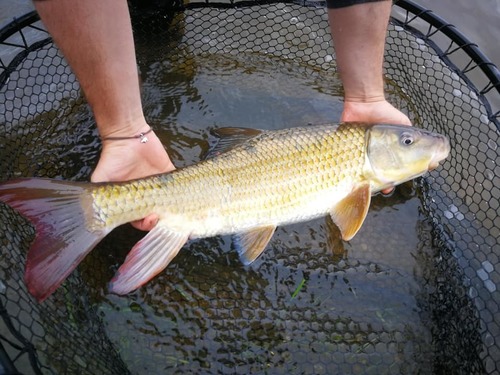
River Redhorse
Moxostoma carinatum
A golden-scaled beauty of the riverbed, the River Redhorse is a sign of a truly healthy waterway. With its striking red fins and impressive size, it is a prized find for any backyard river watcher.
Quick Identification
Size
Typically 10-30 inches (25-76 cm) in length; can weigh between 2 to 10+ lbs (1-4.5 kg) at maturity.
Colors
Sides are olive-bronze to bright gold with a white or pale cream belly; fins are a striking reddish-orange, particularly the tail.
Key Features
- Distinctive reddish-orange tint on the tail and lower fins
- Heavy, blunt head with a large mouth and thick lips
- Large, coarse scales with dark spots at the base
- Crescent-shaped trailing edge on the dorsal fin
When You’ll See Them
Behavior
The River Redhorse is a powerful and somewhat elusive member of the sucker family, often moving in small schools through the deeper, swifter runs of clean rivers. Unlike some of its more tolerant cousins, this species is a 'canary in the coal mine' for water quality; it requires clear, silt-free water and high oxygen levels to thrive. They spend much of their time vacuuming the river bottom, using their highly sensitive lips to detect hidden prey among the rocks.
During the spring spawning season, River Redhorses undergo a dramatic behavior shift, migrating to shallow gravel riffles and shoals. Here, they use their tails to excavate large depressions in the gravel, sometimes referred to as 'redds.' While they are generally wary of humans and quick to dart away from shadows, they can be observed by patient watchers from riverbanks during these shallow-water displays.
EverydayEarth exclusive
Camera Tips
Capturing the River Redhorse requires an underwater camera setup or a very high-vantage shore camera. If you have a backyard stream or river access, focus your efforts on 'glides' or shallow gravel bars during the late spring (typically May). This is when the fish move into shallower water to spawn, making them much easier to film than when they are in deep, dark pools. Position your camera in 12 to 24 inches of water, facing slightly downstream to catch the fish as they move up against the current.
Because these fish are easily spooked by movement and vibrations, a stationary underwater camera (like a GoPro on a weighted tripod or a dedicated underwater stream cam) is far more effective than a handheld one. Use a polarizing filter if shooting from above the water to cut through the surface glare. Look for 'clean' patches of gravel which often indicate active spawning beds or feeding sites where the fish have cleared away algae and silt.
Lighting is your biggest challenge underwater. Try to position the camera so the sun is behind it, illuminating the fish's golden scales and red fins directly. If the water is slightly turbid, keep the camera close to the subject area—within 2 or 3 feet—to maintain clarity. Since River Redhorses are bottom-feeders, keep the lens angle low to the riverbed to capture their unique 'vacuuming' behavior.
While you cannot easily 'bait' a camera for redhorses like you can for birds, you can look for natural attractants. Deep runs immediately downstream from a riffle are natural resting spots. If you are using an AI-powered camera with motion detection, set the sensitivity high, as the swaying of aquatic vegetation can sometimes trigger false positives, but you don't want to miss the sleek, fast movement of a cruising fish.
Similar Species
Species that look similar or are commonly confused with River Redhorse.
Frequently Asked Questions
Record River Redhorse at your habitat
Connect a camera to start building your own species record — AI identifies every visitor automatically.