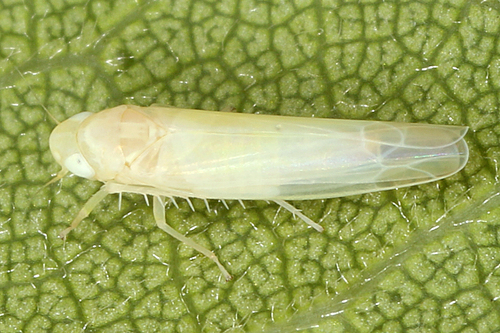
Rose Leafhopper
Edwardsiana rosae
The Rose Leafhopper is a miniature marvel of the garden, a translucent acrobat that thrives in the secret shadows of rose petals and apple leaves.
Quick Identification
Size
3–4 mm (0.12–0.16 inches) in length
Colors
Pale creamy white to light lemon yellow; translucent wings; dark, pin-prick eyes
Key Features
- Slender, wedge-shaped body tapering at the rear
- Translucent wings held roof-like over the body
- Long, powerful hind legs adapted for jumping
- Often found on the undersides of leaves
When You’ll See Them
Behavior
Rose Leafhoppers are exceptionally shy insects known for their incredible leaping ability. At the slightest vibration or shift in light, they use their specialized hind legs to catapult themselves away from danger, often appearing to vanish into thin air. They spend the majority of their lives on the undersides of leaves, moving with a characteristic sideways 'crab-like' walk when they aren't hopping.
While they are solitary and do not form colonies, they are often found in high densities on a single host plant. They communicate with one another using vibrations sent through the stems and leaves of the plant, sounds that are far too quiet for the human ear to detect. They are harmless to humans, though their habit of sucking sap can cause aesthetic 'stippling'—tiny white dots—on the foliage of garden roses.
EverydayEarth exclusive
Camera Tips
To capture the Rose Leafhopper, you need to think small. Because they are only a few millimeters long, a standard trail camera may struggle unless it has a dedicated macro lens or a very short focal distance. Position your camera just 3 to 6 inches away from a rose bush that shows signs of 'stippling'—small white spots on the leaves. Focus specifically on the undersides of the leaves, as this is where the leafhoppers congregate to feed and hide from the sun.
Lighting is critical for such a translucent subject. If possible, set up your camera so that the sun is behind the leaf. This backlighting will make the Rose Leafhopper's pale body 'glow,' making it stand out against the green foliage. If you are using an AI-powered camera, ensure the motion sensitivity is set to high; these insects move quickly, and you’ll want to trigger the shutter the moment they walk into the frame.
Use a tripod or a very stable mount. Because you are working at such high magnification, even a slight breeze can shake the branch and blur the image. If you are trying to capture their famous leap, use a high-speed video setting (60fps or higher). The jump happens in a fraction of a second, and slow-motion playback is the only way to truly appreciate the physics of their movement.
Late spring and early summer are the best times to find nymphs, which are flightless and move slower than the winged adults. These younger stages are much easier to keep in the frame. Avoid using insecticidal soaps or oils on the roses you are monitoring, as these will not only drive the leafhoppers away but can also leave a film on your camera lens that ruins the clarity of your shots.
Similar Species
Species that look similar or are commonly confused with Rose Leafhopper.
Frequently Asked Questions
Record Rose Leafhopper at your habitat
Connect a camera to start building your own species record — AI identifies every visitor automatically.