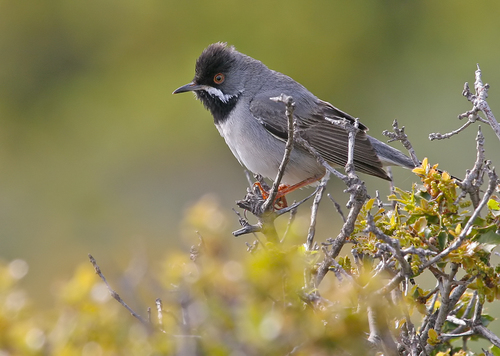
Rüppell's Warbler
Curruca ruppeli
A striking icon of the Mediterranean scrub, the Rüppell’s Warbler stands out with its sharp black hood and vivid red eyes. Watch for this agile traveler as it migrates between the rocky hills of Greece and the wild plains of East Africa.
Quick Identification
Size
Length of 13.5–15 cm (5.3–5.9 in), wingspan of 20–22 cm, and weight between 12–17 grams.
Colors
Males feature a striking black head and throat bisected by a crisp white 'mustache' stripe, with a grey back and pale underparts. Females are more subdued, with a greyish-brown head and a white throat without the bold black hood.
Key Features
- Jet-black crown and throat in males
- Prominent white submoustachial (mustache) stripe
- Bright reddish-orange eye-ring
- Grey upperparts with pale-edged wing feathers
When You’ll See Them
Geographic range
Where Does the Rüppell's Warbler Live?
Rüppell’s Warbler is a Mediterranean specialist, primarily breeding in the coastal and inland scrublands of southern Greece, the Aegean islands, and western and southern Turkey. As a long-distance migrant, it travels across the Mediterranean and the Sahara to spend the winter in the dry thorn-scrub regions of northeast Africa, specifically in Sudan, Chad, and Ethiopia. Occasionally, individual birds may appear as rare vagrants in Western Europe or the Middle East during their seasonal journeys.
Basemap © OpenStreetMap contributors
Behavior
The Rüppell’s Warbler is a spirited and agile songbird, perfectly adapted to the dense, thorny scrub of the Mediterranean. While they can be secretive and 'skulking' as they forage deep within bushes, they become far more conspicuous during the breeding season. Males are known for their energetic song-flights, where they launch themselves into the air to deliver a dry, rattling melody that sounds remarkably like pebbles being clicked together.
These birds are highly territorial during the spring and summer months, patrolling specific patches of maquis or garrigue vegetation. They are primarily solitary outside of the breeding season and during their long-distance migration to East Africa. In their wintering grounds, they maintain a similar lifestyle, darting through acacia scrub to hunt for small invertebrates.
EverydayEarth exclusive
Camera Tips
To capture high-quality footage of a Rüppell’s Warbler, camera placement is everything. These birds are low-altitude specialists, rarely soaring high in trees. Mount your camera between 0.5 and 1 meter off the ground, aiming it at a clearing within a dense patch of scrub or a flat rock that looks like a popular perching spot. Because they are shy, using a camera with a fast trigger speed (under 0.3 seconds) is vital to catch them before they dart back into cover.
Water is the single most effective lure for this species. In the dry, sun-baked environments they call home, a shallow birdbath or a dripping water feature will act as a magnet. Position your camera about 2 to 3 meters away from the water source to ensure the bird is in focus. Natural light is your best friend here; aim for a spot that gets bright morning sun, which will help highlight the male’s distinctive red eye-ring and the contrast of his white mustache against the black throat.
During the spring breeding season (April and May), look for south-facing slopes with plenty of thorny vegetation. Males often use the same prominent twig as a 'song post.' If you can identify one of these perches, set your camera nearby. For settings, use a high-speed burst or 'multi-shot' mode. Warblers are notoriously twitchy, and having a sequence of 3-5 photos will significantly increase your chances of getting one perfectly crisp shot where the bird isn't mid-blink or turning away.
Similar Species
Species that look similar or are commonly confused with Rüppell's Warbler.
Frequently Asked Questions
Record Rüppell's Warbler at your habitat
Connect a camera to start building your own species record — AI identifies every visitor automatically.