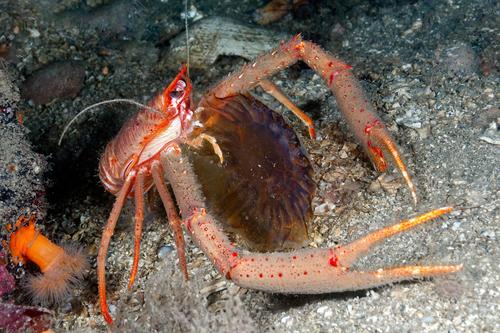
Rugose Squat Lobster
Munida rugosa
With its vibrant orange armor and exceptionally long, slender claws, the Rugose Squat Lobster is a master of the rocky reef. This bold scavenger brings a splash of color to the seafloor, peeking out from crevices across the North Atlantic.
Quick Identification
Size
Carapace length up to 6 cm (2.4 in); total length including claws can reach 15 cm (6 in).
Colors
Primary body color is orange-red to reddish-brown, accented by pale or white-tipped claws and distinct light-colored transverse ridges.
Key Features
- Extremely long, slender pincers (chelipeds) often twice the body length
- Three prominent forward-pointing spines (rostrum) between the eyes
- Deeply textured transverse ridges running across the back
- Tucked-under abdomen giving it a 'squat' appearance
When You’ll See Them
Geographic range
Where Does the Rugose Squat Lobster Live?
Native to the North East Atlantic Ocean, the Rugose Squat Lobster is a common sight from the frigid waters of Norway and the Faroe Islands down to the warmer coasts of Western Sahara. Its core range includes the rugged coastlines of the British Isles, particularly within the sheltered sea lochs of Scotland and the Irish Sea. This species also maintains a significant presence throughout the Mediterranean Sea, where it thrives in both shallow coastal zones and deeper offshore environments.
Basemap © OpenStreetMap contributors
Behavior
The Rugose Squat Lobster is a spirited and somewhat territorial resident of the seafloor. Despite the 'lobster' in its name, it is actually more closely related to hermit crabs, though it does not carry a shell. They are most frequently found peeking out from rocky crevices, under stones, or within the discarded shells of larger mollusks. They are known to be quite bold, brandishing their long, spindly claws to ward off competitors or curious fish that wander too close to their chosen nook.
These crustaceans are both scavengers and active predators. They use their specialized limbs to filter organic particles from the water or to grab small invertebrates passing by. While they are generally solitary and protective of their individual burrows, they can congregate in high numbers in areas with abundant food, such as near seasonal plankton blooms or around deep-sea wrecks. For humans, they are a common sight for divers and are often captured on underwater cameras in sea lochs and sheltered bays.
EverydayEarth exclusive
Camera Tips
Capturing the Rugose Squat Lobster requires a waterproof 'drop camera' or a trail camera inside a specialized underwater housing. To find them, focus your efforts on 'edge' habitats—areas where a rocky reef meets a sandy or muddy bottom. Position your camera on a flat patch of sand facing a cluster of rocks with visible crevices. These lobsters rarely stray far from their hiding spots, so the closer you can get to the rock face, the better your chances of seeing them emerge.
Since light is filtered out quickly underwater, high-quality infrared (IR) or white LED illumination is essential for clear footage. Rugose Squat Lobsters are relatively unfazed by artificial light compared to fish, but using a red filter over your lights can help capture more natural scavenging behavior. If you are deploying the camera in a coastal sea loch or shallow bay, try to set it during a rising tide when nutrients are being pulled in, as this often triggers increased activity.
Bait is the secret weapon for this species. Using a small mesh bag filled with oily fish—such as crushed mackerel, sardines, or even cat food—tethered about 12 to 18 inches in front of the lens will act as an irresistible lure. Within minutes, you are likely to see several individuals scuttling out to investigate. For the best visual impact, aim for a low camera angle. Seeing a Rugose Squat Lobster approach the camera with its long chelipeds outstretched at eye level makes for a dramatic and professional-looking wildlife shot.
Similar Species
Species that look similar or are commonly confused with Rugose Squat Lobster.
Frequently Asked Questions
Record Rugose Squat Lobster at your habitat
Connect a camera to start building your own species record — AI identifies every visitor automatically.