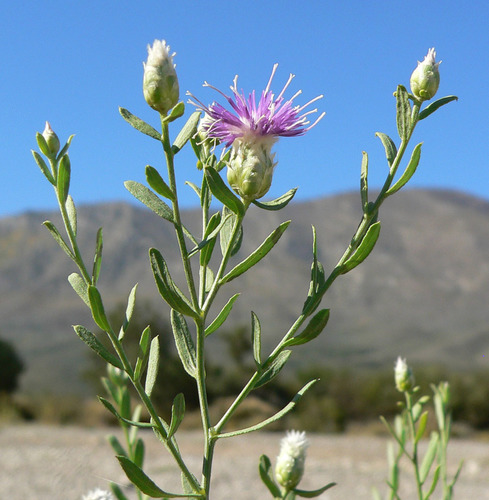
Russian knapweed
Rhaponticum repens
A resilient and aggressive perennial, Russian knapweed is famous for its pearly-tipped flowers and its ability to outcompete almost any neighbor.
Quick Identification
Size
Grows 45–90 cm (18–36 inches) tall with root systems extending up to 6-8 meters (20-26 feet) deep.
Colors
Gray-green to blue-green foliage; flowers range from pink to lavender or light purple; floral bracts are pearly white or straw-colored.
Key Features
- Flower heads surrounded by smooth, papery-tipped bracts (scales)
- Stems are thin, stiff, and covered in fine, cobweb-like hairs
- Deep, dark brown to black scaly rhizomes
- Lower leaves are deeply lobed while upper leaves are narrow and smooth-edged
When You’ll See Them
Geographic range
Where Does the Russian knapweed Live?
Native to the temperate regions of Eurasia, specifically Central Asia and parts of Russia, Russian knapweed has become a widely established invasive species across the globe. In North America, its core range spans the Western United States and Western Canada, where it thrives in the arid and semi-arid climates of the Great Basin and the Rocky Mountain foothills. It has also established significant populations in parts of Australia and South America, often spreading through contaminated hay or agricultural equipment.
Basemap © OpenStreetMap contributors
Behavior
Russian knapweed is a highly aggressive, colony-forming perennial that dominates its environment through a process called allelopathy. The plant releases toxic chemical compounds from its roots into the surrounding soil, which actively inhibits the germination and growth of competing native vegetation. This chemical warfare allows it to form dense, single-species stands that offer very little value to local wildlife.
Beyond its chemical advantages, the species is notoriously difficult to eradicate due to its extensive root system. A single plant can spread horizontally via adventitious buds on its rhizomes, creating a vast underground network. In residential and agricultural settings, it is often viewed as a major nuisance, particularly because it is toxic to horses, causing a neurological condition known as 'chewing disease' if consumed in large quantities.
EverydayEarth exclusive
Camera Tips
Capturing Russian knapweed on a backyard or trail camera is a great way to monitor for invasive species encroachment. To get the best identification shots for AI processing, position your camera at a low height, approximately 12 to 18 inches off the ground. This allows the lens to focus on the unique 'involucre'—the cup-like structure of bracts beneath the flower petals—which is the most reliable way to distinguish this plant from other knapweed varieties.
Since this is a stationary subject, use a camera with a good macro setting or a high-resolution sensor that allows for digital zooming. If you are using a trigger-based trail camera, set it to 'Time Lapse' mode rather than 'Motion' mode. Setting the camera to take a photo every 4 to 6 hours during daylight will allow you to see the plant's development from a basal rosette in the spring to its distinctive purple blooms in late summer.
Lighting is crucial for capturing the silver-green texture of the stems. Early morning or late afternoon light (the 'golden hour') prevents the papery white bracts from appearing blown out or overexposed. If your camera is placed in a windy area, use a faster shutter speed to avoid the motion blur that occurs when the thin, wiry stems sway. For those tracking its spread, place the camera at the edge of a suspected patch to document how quickly the rhizomes are advancing into your lawn or garden area.
Similar Species
Species that look similar or are commonly confused with Russian knapweed.
Frequently Asked Questions
Record Russian knapweed at your habitat
Connect a camera to start building your own species record — AI identifies every visitor automatically.