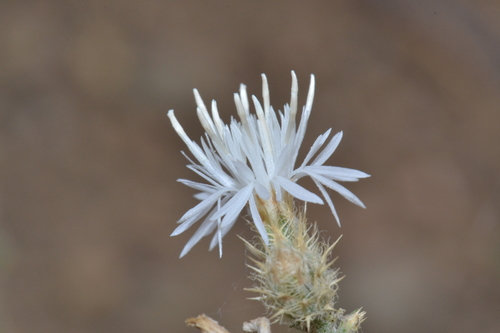
diffuse knapweed
Centaurea diffusa
A master of survival and seed dispersal, Diffuse Knapweed is a hardy Mediterranean traveler that has reshaped the landscapes of the American West. Its delicate white flowers and tumbleweed antics hide a fierce competitor that thrives where others cannot.
Quick Identification
Size
Height ranges from 10 to 60 cm (4 to 24 inches); flower heads are approximately 0.5 to 1 cm (0.2 to 0.4 inches) wide.
Colors
Gray-green stems and leaves; flowers are typically white, but occasionally light pink or lavender.
Key Features
- Stiff, highly branched stems giving the plant a bushy appearance
- Flower bracts end in a sharp, rigid spine with small lateral teeth
- Bracts lack the dark 'spotted' tips found on similar species
- Dried plants break at the base to roll as tumbleweeds
When You’ll See Them
Geographic range
Where Does the diffuse knapweed Live?
Originally native to the arid regions of the eastern Mediterranean and western Asia, including nations like Turkey, Bulgaria, and Ukraine, diffuse knapweed has staged a massive expansion across the globe. It is now most famously established as a widespread invasive species throughout the western United States and southern Canada, particularly in the Intermountain West. It thrives in temperate, semi-arid environments where it can outcompete native bunchgrasses and shrubs, often dominating entire hillsides from British Columbia down to the Mexican border.
Basemap © OpenStreetMap contributors
Behavior
In the late summer and autumn, once the seeds have matured, the plant undergoes a dramatic transformation. The main stem becomes extremely brittle and eventually snaps off at the soil line. The entire plant then becomes a tumbleweed, using the wind to bounce across fields and roadsides. This movement efficiently shakes seeds out of the dried flower heads, allowing the species to spread its offspring over vast distances in a single season.
EverydayEarth exclusive
Camera Tips
During the flowering months of July and August, focus your camera on the flower heads. Diffuse knapweed is a major draw for pollinators; you are likely to capture a variety of bees, butterflies, and predatory wasps. This is also the best time to look for biocontrol insects, such as the knapweed seed head weevil or the knapweed root-boring moth, which were introduced to manage the plant's spread. Use a high-shutter speed setting to freeze the motion of these fast-moving insects against the white blooms.
In the autumn, the plant turns into a tumbleweed. This is a great opportunity to use motion-trigger settings to see how the plant interacts with the wind. However, be careful with sensitivity; the swaying of dry knapweed stems can cause hundreds of 'false' triggers. To avoid this, use a 'detection zone' feature to focus the trigger on a specific area of the ground where you expect the plant to break off or where animals might come to forage on the remaining seeds during the winter months.
Similar Species
Species that look similar or are commonly confused with diffuse knapweed.
Spotted Knapweed
Look for dark, spot-like tips on the flower bracts and pinker flowers compared to the white flowers of diffuse knapweed.
Russian Knapweed
Russian knapweed has smooth, papery bracts without spines and spreads via creeping underground roots rather than tumbleweed action.
Squarrose Knapweed
Very similar to diffuse, but its bract spines are curved backwards (recurved) and the flower heads are slightly smaller.
Frequently Asked Questions
Record diffuse knapweed at your habitat
Connect a camera to start building your own species record — AI identifies every visitor automatically.