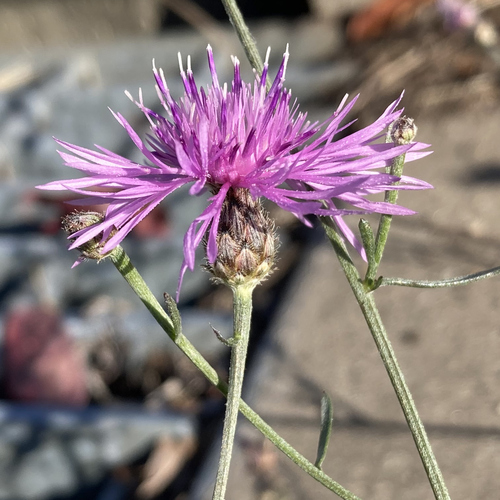
spotted knapweed
Centaurea stoebe
An aggressive survivor from Eastern Europe, spotted knapweed is a master of adaptation. Known for its 'spotted' purple blooms and its ability to outcompete native flora, it is a fascinating, if notorious, resident of the modern backyard.
Quick Identification
Size
Stands 30–120 cm (1–4 feet) tall with flower heads approximately 2 cm (0.75 in) wide
Colors
Pinkish-purple to lavender flowers with gray-green foliage and black-tipped bracts
Key Features
- Pinkish-purple thistle-like flower heads
- Distinctive black-tipped bracts resembling spots
- Deeply lobed, grayish-green leaves with a rough texture
- Highly branched stems arising from a sturdy central taproot
When You’ll See Them
Geographic range
Where Does the spotted knapweed Live?
Originally native to the temperate regions of Eastern Europe and Western Asia, spotted knapweed has successfully colonized much of the globe. It is most notorious as a widespread invasive species across North America, where it can be found in nearly every U.S. state and Canadian province, particularly favoring the Rocky Mountains and the Pacific Northwest. Its ability to withstand drought and thrive in sandy, gravelly soil has allowed it to invade millions of acres of rangeland and wild territory.
Basemap © OpenStreetMap contributors
Behavior
The species is a prolific seed producer; a single healthy plant can release up to 25,000 seeds annually. These seeds are equipped with a small, feathery pappus that allows them to be carried by the wind or hitch a ride on animal fur and vehicle tires. In the winter, the dried stalks often snap at the base, transforming the entire plant into a tumbleweed that rolls across the landscape, scattering seeds as it goes.
EverydayEarth exclusive
Camera Tips
To capture the striking lifecycle of spotted knapweed on your AI-powered camera, focus on the flowering period between mid-summer and early autumn. Position your camera on a short tripod or ground stake about 12 to 18 inches off the ground, angled slightly upward. This perspective allows you to highlight the intricate detail of the flower heads and the distinctive black-tipped bracts that give the species its name. Using a macro lens or setting your camera to a close-focus mode will provide the best results for clear identification.
While the plant itself is stationary, it acts as a high-traffic hub for pollinators. You can use a cluster of knapweed as a natural 'lure' for your camera. By aiming your device at a healthy bloom during peak daylight hours, you are likely to capture a flurry of activity from honeybees, bumblebees, and various butterfly species. Set your trigger sensitivity high to catch these fast-moving visitors, or use a time-lapse setting to document the flowers opening and closing with the sun.
For the most visually compelling shots, take advantage of the 'golden hour'—the hour just after sunrise or before sunset. The low-angle light catches the fine, silvery hairs on the leaves and makes the purple petals pop against the gray-green foliage. In the winter months, you can even attempt to capture the plant's 'tumbleweed' behavior by placing a camera in a wide-angle orientation overlooking an open field during a windstorm, which may document the dried stalks being swept across the landscape.
Similar Species
Species that look similar or are commonly confused with spotted knapweed.
Diffuse Knapweed
Diffuse knapweed has white or very pale flowers and its bracts end in a sharp, rigid spine rather than a dark spot.
Russian Knapweed
Russian knapweed bracts are rounded with papery, translucent edges and completely lack the black 'spots' of Centaurea stoebe.
Bull Thistle
Bull thistles are much larger and more robust, featuring sharp spines all along the stems and leaves, which knapweed lacks.
Frequently Asked Questions
Record spotted knapweed at your habitat
Connect a camera to start building your own species record — AI identifies every visitor automatically.