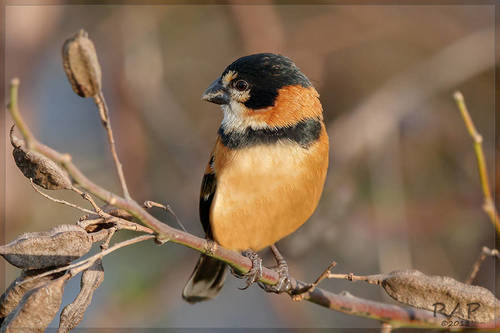
Rusty-collared Seedeater
Sporophila collaris
A gem of the South American grasslands, the Rusty-collared Seedeater is famous for its vibrant rufous chest band and its acrobatic foraging style. Watch for these nimble birds as they dance among the tall grass stems in search of their next meal.
Quick Identification
Size
Length: 10–12 cm (4–4.7 in); Weight: 7.5–14 g (0.26–0.49 oz)
Colors
Males have a black crown and face, white throat, and a bold rusty-orange band across the breast. Females are overall olive-brown with paler buff underparts.
Key Features
- Striking rusty-orange or rufous band across the male's chest
- Black 'cap' and cheeks contrasted with a white throat area
- Thick, stubby black beak optimized for cracking seeds
- Small white patches on the wings visible during flight
When You’ll See Them
Behavior
The Rusty-collared Seedeater is a social and highly energetic songbird, most often observed clinging to the stems of tall grasses. During the breeding season, males become very conspicuous, perching on high reeds or fence wires to deliver a complex, warbling song designed to defend their territory and attract mates. They are quite nimble, frequently moving in a 'climbing' motion up and down vertical stalks to reach seed heads.
Outside of the breeding season, these birds often gather in small, friendly groups and may even join mixed-species flocks with other seedeaters and finches. While they can be wary of direct human approach, they are relatively well-adapted to living near rural gardens and agricultural edges, provided there is enough tall grass left for foraging and nesting.
EverydayEarth exclusive
Camera Tips
To capture high-quality footage of the Rusty-collared Seedeater, camera placement is everything. These birds prefer the 'edge' effect—the transition zone between tall grass and open space. Position your AI-powered camera approximately 3 to 4 feet off the ground, facing a patch of native, seed-bearing grasses or a designated 'perch' branch. If you can place the camera near a water source like a shallow birdbath or a dripping fountain, you are much more likely to get clear, stationary shots as they pause to drink and bathe.
Because these birds are small and move with quick, jerky motions, set your camera to its highest trigger sensitivity. If your camera allows for it, a fast shutter speed is ideal to prevent motion blur when they flutter between grass stalks. For lighting, try to have the sun at the camera's back during the early morning hours; this 'front-lighting' will make the male's vibrant rusty collar and black cap pop against the green background, which is essential for accurate AI identification.
While they are mostly attracted to natural forage, you can lure them into the camera's frame using a tray feeder filled with nyjer (thistle) or very fine-cracked corn. Avoid deep hopper feeders, as these birds prefer to scan their surroundings while eating. If you live in a region where they are migratory, focus your efforts during the southern spring (starting in October) when males are most active and vocal. During this time, they often return to the same singing post every morning; find that post, and you have the perfect spot for your camera.
Lastly, consider the background of your shot. Since these birds are olive and brown (especially the females), a cluttered or dark background can make them disappear. Try to frame your shot so there is some distance between the bird's perch and the vegetation behind it. This creates a soft, blurred background that makes the bird's specific markings—like the male's white wing spots—much easier to see in your saved clips.
Similar Species
Species that look similar or are commonly confused with Rusty-collared Seedeater.
Double-collared Seedeater
The male has two black bands across a white chest and lacks any rusty or rufous coloration.
Lined Seedeater
Features a prominent white stripe down the center of its black crown and lacks the rusty breast band.
Yellow-bellied Seedeater
Males have a black head and olive back, but the underparts are distinctly pale yellow rather than rusty or white.
Frequently Asked Questions
Record Rusty-collared Seedeater at your habitat
Connect a camera to start building your own species record — AI identifies every visitor automatically.