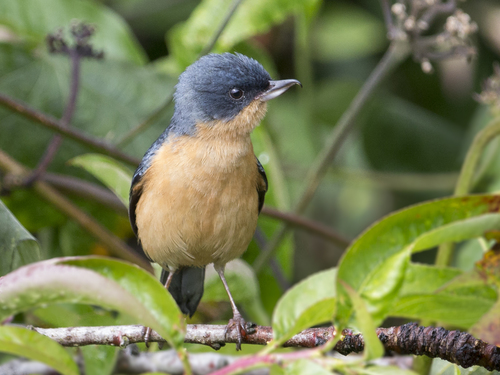
Rusty Flowerpiercer
Diglossa sittoides
The clever burglar of the bird world, the Rusty Flowerpiercer uses a hooked bill to steal nectar from the most beautiful blooms. A vibrant and energetic Andean native, it brings a splash of cinnamon color to high-altitude gardens.
Quick Identification
Size
4.3 to 4.7 inches (11-12 cm) in length; weighs approximately 0.3 to 0.4 oz (9-12 g)
Colors
Males feature a slaty-blue back and head with rich cinnamon-rusty underparts. Females are duller, with olive-brown upperparts and pale buff, lightly streaked underparts.
Key Features
- Distinctive hooked tip on the upper mandible of the bill
- Male's contrasting slate-grey upperparts and rusty orange belly
- Frequent perching on flower stems rather than hovering
- Small, active bird with a constant 'flicking' motion
When You’ll See Them
Behavior
The Rusty Flowerpiercer is famously known as a "nectar robber." Unlike hummingbirds that facilitate pollination by entering the front of a flower, this clever bird uses its specialized hooked bill to pierce the base of tubular flowers. It then laps up the nectar through the hole, bypassing the plant's reproductive organs entirely. This behavior makes them a fascinating, if slightly mischievous, visitor to high-altitude gardens.
These birds are generally solitary and highly territorial. They are often seen chasing away larger birds or competing hummingbirds from a particularly rich patch of flowers. While they spend most of their time near nectar sources, they are also quite agile at catching small insects mid-air or gleaning them from foliage to supplement their protein intake.
In backyard settings, they are less shy than many forest birds and will readily inhabit suburban gardens that offer plenty of cover and flowering shrubs. They have a rapid, nervous energy, rarely staying in one spot for more than a few seconds, which makes them a fun challenge for wildlife observers and photographers.
EverydayEarth exclusive
Camera Tips
To capture the Rusty Flowerpiercer on an AI-powered camera, you must think like a nectar robber. Unlike hummingbirds that hover, flowerpiercers need a sturdy perch to reach the base of a flower. Focus your camera on clusters of tubular flowers such as Fuchsia, Salvia, or Trumpet Creeper. Position the lens about 2 to 3 feet away from the blooms, ensuring the camera is at the same height as the flowers (usually 3 to 5 feet off the ground).
Because these birds are incredibly fast, set your camera to its highest possible frame rate (60fps is ideal) and use a fast shutter speed to avoid motion blur. If your camera has a 'Star-Light' or high-sensitivity sensor, it will help capture the rich cinnamon tones of the male's belly, which can sometimes appear dark or shadowed in the dense foliage where they like to hide.
Baiting with traditional seeds won't work for this species. Instead, plant native Andean shrubs or use a nectar feeder with a very prominent perch. If you use a feeder, place the camera to the side rather than head-on; this allows the AI to see the bird's profile, specifically the hooked bill and the color contrast between the back and belly, which are key for accurate identification.
Early morning is the best time for recording. Flowerpiercers are most active just after sunrise when nectar levels in flowers are at their peak. Ensure your camera is not facing directly into the morning sun to avoid lens flare, which can confuse the AI's motion detection. If your camera supports 'pre-roll' or 'buffer' recording, enable it—these birds often fly in and out of the frame so quickly that standard sensors might miss the start of the action.
Similar Species
Species that look similar or are commonly confused with Rusty Flowerpiercer.
Glossy Flowerpiercer
Much darker overall; lacks the rusty cinnamon belly and has a black chest.
Slaty Flowerpiercer
Very similar but generally lacks the vibrant cinnamon underparts, appearing more uniform grey or dull buff below.
Cinnamon-bellied Flowerpiercer
Found in similar habitats but has a much more restricted range and typically shows a more extensive cinnamon wash up to the throat.
Frequently Asked Questions
Record Rusty Flowerpiercer at your habitat
Connect a camera to start building your own species record — AI identifies every visitor automatically.