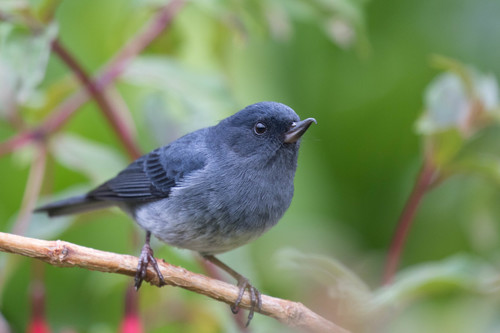
Slaty Flowerpiercer
Diglossa plumbea
A tiny, slate-colored specialist of the Central American highlands, the Slaty Flowerpiercer is famous for its 'thievish' nectar-robbing habits and its uniquely hooked bill.
Quick Identification
Size
Length: 10 cm (4 in); Weight: 9–11 g (0.3–0.4 oz)
Colors
Males are a uniform slaty-blue or lead-gray with darker flight feathers; females are olive-brown above and paler, buffy-brown below.
Key Features
- Distinctly hooked upper mandible with an upturned lower mandible
- Small, active songbird with a short tail
- Male has uniform lead-gray plumage
- Endemic to high-altitude Talamancan ranges
When You’ll See Them
Behavior
The Slaty Flowerpiercer is a fascinating "nectar thief" of the high-altitude cloud forests. Unlike hummingbirds that reach deep into flowers to pollinate them, this clever bird uses its specialized bill to pierce the base of tubular corollas, drinking the nectar through the side. This evolutionary shortcut allows them to access food sources that their bill shape wouldn't otherwise permit, though it means they rarely provide pollination services to the plants they visit.
These birds are highly active and can be quite territorial, often defending a specific patch of flowering shrubs from other flowerpiercers or even larger birds. In backyard settings within their limited range, they are surprisingly bold and habituated to human presence. They move with quick, jerky motions through the undergrowth, occasionally letting out a thin, high-pitched song that consists of a series of buzzy notes.
EverydayEarth exclusive
Camera Tips
To capture the Slaty Flowerpiercer on camera, you must focus on their specific feeding strategy. Instead of pointing your camera at a traditional seed feeder, aim it directly at native tubular flowers such as *Fuchsia*, *Salvia*, or *Centropogon*. These birds are creatures of habit and will return to the same flowering bushes multiple times a day. Mount your camera at eye level with the flowers—roughly 3 to 5 feet off the ground—and ensure you have a clear line of sight to the base of the blooms, as that is where the action happens.
Lighting in the Talamancan cloud forest can be tricky due to frequent mist and shade. Position your camera to take advantage of the brighter morning light before the afternoon fog rolls in. If your AI camera allows for custom trigger zones, set the zone specifically around the flower clusters. Because these birds are small and move with rapid, darting motions, use a high sensitivity setting and a fast shutter speed (or high frame rate) to avoid capturing nothing but a slate-colored blur.
Since the Slaty Flowerpiercer lives in high-humidity environments, ensure your camera housing is well-sealed against moisture. A unique way to attract them for a close-up is to provide a shallow, elevated birdbath near their favorite nectar source. They are meticulous about cleaning sticky nectar off their feathers and will often visit water features for a quick dip. For the most professional-looking shots, use a camera with a macro or close-focus lens, as these birds will often forage within inches of the foliage.
Similar Species
Species that look similar or are commonly confused with Slaty Flowerpiercer.
Cinnamon-bellied Flowerpiercer
Much larger than the Slaty, with bright cinnamon-orange underparts instead of uniform gray or brown.
Bananaquit
Also pierces flowers for nectar but has a bright yellow belly and a prominent white eyebrow stripe.
Slaty Finch
Lacks the specialized hooked bill of the flowerpiercer and has a much thicker, triangular bill for cracking seeds.
Frequently Asked Questions
Record Slaty Flowerpiercer at your habitat
Connect a camera to start building your own species record — AI identifies every visitor automatically.