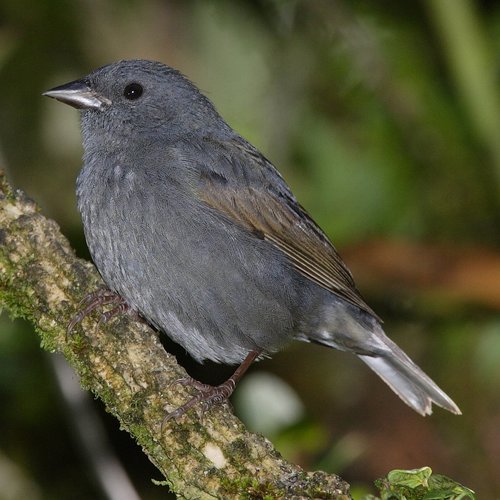
Slaty Finch
Haplospiza rustica
A secretive nomad of the mountain forests, the Slaty Finch is a prize find for any backyard observer. Discover the subtle beauty of this bamboo-loving specialist through the lens of your AI camera.
Quick Identification
Size
4.7–5.1 inches (12–13 cm) in length; weighs 0.46–0.63 oz (13–18 g)
Colors
Males are a uniform, matte slaty gray; females are olive-brown with heavy dark streaking on the breast and belly.
Key Features
- Uniform deep gray plumage in males
- Heavily streaked underparts in females
- Pointed, conical dark bill
- Nomadic behavior linked to bamboo
- Short, slightly notched tail
When You’ll See Them
Behavior
The Slaty Finch is a master of the "disappearing act." Unlike many of its social cousins in the tanager family, this species is known for its nomadic lifestyle, wandering through high-altitude forests in search of its primary food source: flowering bamboo. They are generally quiet and secretive, often foraging low in the understory or hopping through leaf litter, making them a challenge even for experienced birdwatchers to spot.
When bamboo masting occurs—a rare event where large stands of bamboo flower and seed simultaneously—Slaty Finches may suddenly appear in large numbers. During these times, they become much more social and vocal. Outside of these events, you'll likely find them in pairs or small family groups, moving stealthily through dense thickets and forest edges where they blend perfectly into the shadows.
EverydayEarth exclusive
Camera Tips
Capturing the Slaty Finch on camera requires a strategy focused on their specific habitat: bamboo. Since these birds are "bamboo specialists," placing your AI camera near dense bamboo stands or at the edge of secondary growth forests is your best bet. Position the camera low, about 2 to 4 feet off the ground, as these birds spend a significant amount of time foraging in the leaf litter or on low-hanging seed heads. A slight downward angle will help capture the characteristic streaking on the females' breasts as they look for fallen seeds.
Because they are nomadic and quiet, you might go months without a sighting followed by a flurry of activity. To increase your chances, look for signs of flowering bamboo in your area. If you see bamboo producing seeds, set your camera to "high sensitivity" or "burst mode." These birds move quickly when feeding and can be easily missed by slower triggers. Using a camera with a fast shutter speed is essential to get a crisp shot of the male’s uniform gray plumage without motion blur, which can often look like a simple shadow in low light.
In terms of lures, standard birdseed mixes might work, but they are less effective than natural attractants. If you have a water feature like a shallow birdbath or a slow-dripping misting system near a forest edge, the Slaty Finch is much more likely to visit. They prefer quiet, secluded spots for bathing where they feel protected by overhead cover. Ensure your camera is set to record during the early morning hours, as they are most active just after sunrise when the forest is still damp and cool.
Similar Species
Species that look similar or are commonly confused with Slaty Finch.
Plumbeous Sierra Finch
The Sierra Finch has a much heavier bill and prefers more open, rocky highland habitats compared to the bamboo-loving Slaty Finch.
Blue-black Grassquit
Males are a glossy blue-black rather than matte gray, and they perform a signature vertical jumping display.
Slaty Flowerpiercer
Features a unique upturned bill with a hooked tip, unlike the straight conical bill of the Slaty Finch.
Frequently Asked Questions
Record Slaty Finch at your habitat
Connect a camera to start building your own species record — AI identifies every visitor automatically.