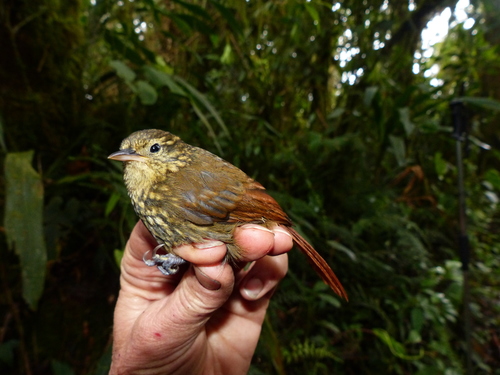
Rusty-winged Barbtail
Premnornis guttuliger
A master of the Andean cloud forest, the Rusty-winged Barbtail is known for its vibrant rufous wings and its habit of climbing mossy trunks like a tiny, feathered acrobat. This elusive ovenbird is a prized find for birdwatchers and camera trappers alike in the misty highlands of South America.
Quick Identification
Size
13–15 cm (5.1–5.9 in); 13–19 g (0.46–0.67 oz)
Colors
Olive-brown body with distinct rufous (rusty) wings and tail; throat and breast are buffy with pale, teardrop-shaped spots.
Key Features
- Bright rufous-chestnut wings and tail
- Streaked buffy-white teardrop spots on chest and throat
- Stiff-shafted tail feathers used for propping against bark
- Thin, dark bill with a pale base to the lower mandible
When You’ll See Them
Geographic range
Where Does the Rusty-winged Barbtail Live?
This elusive bird is native to the South American continent, specifically hugging the rugged spine of the Andes Mountains. Its core range spans from the coastal mountains of northern Venezuela through the eastern and central ranges of Colombia, extending south through the moist forests of Ecuador and ending in the highlands of Peru. Because it requires high-elevation mossy forests, its distribution is narrow and follows the specific climatic conditions of the tropical Andean belt.
Basemap © OpenStreetMap contributors
Behavior
The Rusty-winged Barbtail is a tireless explorer of the misty Andean cloud forests. Unlike some of its more gregarious ovenbird relatives, this species is often found foraging alone or in pairs, though it frequently joins mixed-species flocks as they move through the lower and middle stories of the forest. It is a specialist of the "vertical world," nimbly climbing moss-covered trunks and hopping through dense tangles of epiphytes in search of hidden prey.
Its behavior is characterized by a "hitch-and-glean" movement. It uses its stiff tail feathers as a prop against bark, similar to a woodpecker or woodcreeper, but it is far more agile in the thin, branchy undergrowth. While generally shy and unobtrusive, its presence is often given away by its sharp, high-pitched calls that cut through the damp forest air. They are not known to be particularly bold around humans, preferring the cover of dense, mossy vegetation.
EverydayEarth exclusive
Camera Tips
Capturing the Rusty-winged Barbtail on camera requires a focus on the mid-story and understory layers of humid montane environments. Set your camera at a height of 3 to 6 feet (1 to 2 meters), aiming it toward horizontal, moss-covered branches or dense vine tangles. This species is attracted to areas rich in epiphytes and bromeliads where it forages for insects, so positioning the lens near these micro-habitats increases your chances of a clear shot.
Because cloud forests are notoriously dim, high-quality infrared sensors and fast shutter speeds are essential to avoid motion blur from this active bird. Use a camera with a "Fast Trigger" setting, as the barbtail doesn't stay in one spot for long. If you are using a backyard camera near a forest edge in its native range, providing a slow-dripping water feature can be a major draw, as these birds often seek out clean water for bathing in the humid air.
Lighting is your biggest challenge in the Andean canopy. Try to position the camera where it can benefit from filtered morning light, but avoid direct glare which can wash out the subtle teardrop patterns on the bird's breast. If your camera supports burst mode, set it to take 3-5 photos per trigger; the bird’s rapid "hitching" movement means that the first shot might only catch its tail, while the third or fourth might capture its distinctive face and rufous wings.
Similar Species
Species that look similar or are commonly confused with Rusty-winged Barbtail.
Frequently Asked Questions
Record Rusty-winged Barbtail at your habitat
Connect a camera to start building your own species record — AI identifies every visitor automatically.