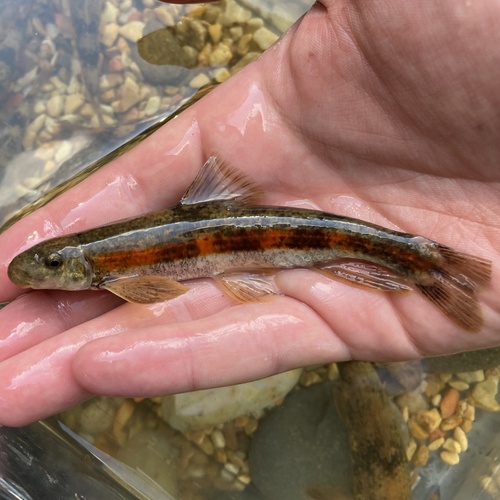
Rustyside Sucker
Thoburnia hamiltoni
A rare gem of the Southeast's mountain waters, the Rustyside Sucker is a master of the rocky stream bed. Found only in a narrow range of Virginia and North Carolina, this colorful bottom-dweller is a prize find for any underwater wildlife enthusiast.
Quick Identification
Size
3 to 6 inches (7.5 to 15 cm) in length; weight typically under 2 ounces (56 g)
Colors
Olive to dark brown back with dark 'saddle' blotches; a prominent reddish-orange or 'rusty' horizontal stripe runs along the side; pale white or cream belly
Key Features
- Slender, cylindrical body shape
- Prominent rusty-red horizontal band along the sides
- 6-7 dark saddle-like markings across the back
- Subterminal mouth with fleshy lips for scraping rocks
When You’ll See Them
Behavior
The Rustyside Sucker is a highly specialized bottom-dweller that spends its life navigating the rocky substrates of fast-moving mountain streams. They are expert 'scrapers,' using their downward-oriented mouths to harvest biofilm and algae from the surface of stones. Unlike many other fish that school in the open water column, these suckers hug the bottom, using the current to their advantage to stay anchored while they feed.
They are generally solitary or found in very small groups, often hiding in the crevices between large cobbles or boulders when threatened. They are sensitive to environmental changes, particularly sedimentation and water temperature increases, making them an 'indicator species' for the health of their river systems. During the spring, they become more active as they move toward shallow, gravelly riffles to spawn, which is when their colors are most vibrant.
EverydayEarth exclusive
Camera Tips
Capturing the Rustyside Sucker on camera requires a specialized underwater approach, as they never surface. To find them, you must focus on the clear, rocky streams of the Roanoke or Dan River drainages in Virginia and North Carolina. Use a waterproof action camera or a trail camera in a dedicated dive housing. The best placement is on the downstream side of a large boulder or in a transition zone between a fast riffle and a deeper pool. Use a weighted low-profile mount or a small tripod weighed down with lead divers' weights to ensure the camera doesn't shift in the current.
Because these fish are small and stay close to the bottom, position your lens only a few inches above the substrate, angled slightly upward. This 'worm's eye view' provides the best chance of capturing the characteristic rusty stripe along their sides. Lighting is critical; try to set up in a spot where the sun penetrates the water directly between 11 AM and 2 PM. Avoid using artificial lights if possible, as the reflection off suspended particles (backscatter) can ruin the clarity of the shot, though a subtle, high-CRI video light can help if the stream is heavily shaded by forest canopy.
Focus settings are the biggest hurdle. If your camera has a manual focus or a 'macro' mode, set it to focus roughly 12 to 24 inches in front of the lens. Use a high frame rate (at least 60fps) because, while they look slow while grazing, they are incredibly fast when they dart away. To encourage them to stay in frame, look for a 'feeding rock'—a flat stone with visible green or brown algae growth—and center your shot on that specific spot. Patience is key, as it may take several hours for the fish to become comfortable with a new object in their environment.
Similar Species
Species that look similar or are commonly confused with Rustyside Sucker.
Frequently Asked Questions
Record Rustyside Sucker at your habitat
Connect a camera to start building your own species record — AI identifies every visitor automatically.