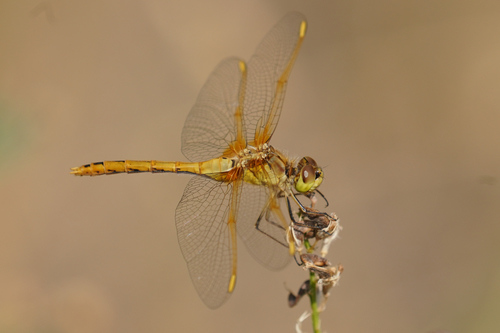
Saffron-winged Meadowhawk
Sympetrum costiferum
A late-season gem of the insect world, the Saffron-winged Meadowhawk brings a flash of brilliant red and gold to the autumn garden. Discover how to spot this resilient percher and its shimmering golden wings.
Quick Identification
Size
Length: 1.2–1.5 inches (30–38 mm); Wingspan: 2.0–2.4 inches (50–60 mm)
Colors
Mature males are vibrant red; females and juveniles are golden-yellow to brownish. Both sexes feature a distinctive saffron-yellow tint along the leading edge of the wings.
Key Features
- Golden-yellow tint along the leading edge (costa) of the wings
- Legs are typically pale or striped with yellow/tan, rather than solid black
- Small, slender abdomen that turns bright scarlet in mature males
- Stigma (wing spots) are often reddish or dark orange
When You’ll See Them
Behavior
The Saffron-winged Meadowhawk is a classic 'percher' dragonfly. Instead of patrolling the air for hours like larger darners, these insects prefer to sit on a sun-drenched twig, reed, or even a garden stake, darting out with precision to intercept small flying prey. They are remarkably resilient to cooler temperatures, often remaining active late into the autumn when most other dragonfly species have disappeared.
In the backyard setting, they are relatively bold and will often allow a close approach. Males are highly territorial over their chosen sunning spots and will frequently engage in rapid, spiraling aerial duels with rivals. They are also known for 'obelisking' during extreme heat—pointing their abdomens straight up toward the sun to minimize the surface area exposed to heat, a fascinating behavior to catch on camera.
EverydayEarth exclusive
Camera Tips
To capture high-quality footage of the Saffron-winged Meadowhawk, you must understand their perching habits. They almost always return to the same prominent 'lookout' point after hunting. Identify a tall, solitary reed, a bamboo garden stake, or a thin dry branch near water or a flowering meadow. Mount your AI camera roughly 12 to 24 inches away from this perch, angled slightly upward to catch the blue sky as a backdrop, which makes the male's red body and saffron wings pop in the frame.
Because dragonflies move with lightning speed, use a high frame rate setting if your camera allows. Since these dragonflies are most active in full sun, ensure your camera lens is shaded to prevent lens flare, while the perch itself remains in bright, direct light. This lighting is essential for revealing the delicate golden 'saffron' tint on the wing edges that gives this species its name.
You can 'bait' these dragonflies by providing the perfect habitat. If you don't have a pond, a simple birdbath with a few tall, upright sticks placed in the center can act as a magnet for them. They use these sticks as launchpads for hunting mosquitoes. Set your camera's motion trigger sensitivity to high, as insects have less mass than birds or mammals and might not always trigger standard PIR sensors.
Late summer and early autumn are the best times for filming. As the morning air is often cool, the dragonflies will be less active and may sit for long periods on their perches to warm up. This is the ideal window for capturing crisp, still images before they become too fast to track during the heat of the afternoon. If your camera has a macro mode or a close-focusing lens, use it; these dragonflies are small, and filling the frame is key to a 'hero' shot.
Similar Species
Species that look similar or are commonly confused with Saffron-winged Meadowhawk.
Ruby Meadowhawk
The Ruby Meadowhawk has solid black legs and lacks the saffron-colored tint on the leading edge of its wings.
Autumn Meadowhawk
Autumn Meadowhawks have distinctly pale, all-yellow or tan legs and the males are a slightly different shade of brick-red.
White-faced Meadowhawk
Features a prominent white face in mature individuals and lacks the golden wing coloration.
Frequently Asked Questions
Record Saffron-winged Meadowhawk at your habitat
Connect a camera to start building your own species record — AI identifies every visitor automatically.