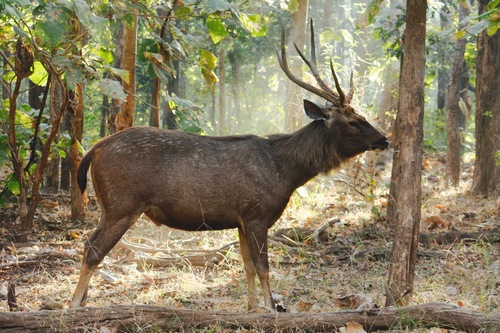
Sambar
Rusa unicolor
The Sambar is the ghost of the Asian forest—a massive, shaggy deer known for its incredible stealth and majestic three-tined antlers. Seeing one on camera is a rare treat that marks you as a true backyard explorer.
Quick Identification
Size
Shoulder height 100-160 cm (40-63 in); Weight 100-350 kg (220-770 lbs), though large males can reach 550 kg (1200 lbs).
Colors
Dark brown to charcoal grey coat; yellowish-brown or pale undersides; males develop a dense, dark mane around the neck.
Key Features
- Large flared 'Mickey Mouse' ears
- Sturdy three-tined antlers on males
- Thick, shaggy neck mane
- Massive, powerful build compared to other deer
When You’ll See Them
Behavior
Sambar are the quiet heavyweights of the forest. Unlike many deer species that congregate in large, noisy herds, the Sambar is a relatively solitary and elusive animal. They are most often found alone or in small family units consisting of a mother and her young. They are incredibly wary and possess an acute sense of hearing and smell, often detecting a human presence long before they are seen. When threatened, they emit a loud, hollow barking alarm call that alerts the entire forest to danger.
These deer are surprisingly comfortable in the water and are excellent swimmers, often wading deep into ponds to graze on aquatic vegetation or escaping into rivers to lose a predator's scent. In areas with high human activity, they have become almost entirely nocturnal, retreating into the thickest cover during the daylight hours. During the rut, males become more active and vocal, marking their territory by rubbing their antlers against trees and 'wallowing' in mud to coat themselves in scent.
EverydayEarth exclusive
Camera Tips
Capturing the Sambar on a trail camera requires a blend of stealth and strategy because of their heightened sensitivity to new objects. To get the best shots, place your camera near water sources like secluded ponds or slow-moving streams, as Sambar are frequent drinkers and love to wade. Mount the camera higher than you would for a typical deer—roughly 4 to 5 feet up—and angle it slightly downward. This prevents the animal's massive body from filling the entire frame and ensures you capture the impressive antlers of the stags.
Because Sambar are most active in low light, use a camera with 'No-Glow' or high-end infrared LEDs. They are remarkably perceptive and can be spooked by the faint red glow of standard infrared cameras. Set your trigger speed to the fastest possible setting (0.5 seconds or less) and use 'Burst Mode' to capture a sequence of 3-5 photos. This increases your chances of getting a clear shot of their head and ears, which are often in constant motion as they scan for threats.
If you are monitoring a large area, look for 'wallows'—muddy depressions in the ground where males roll to mark their territory. These are hotspots for camera activity during the breeding season. For baiting where legal, Sambar are highly attracted to salt licks and mineral blocks, especially in the dry season. If placing a camera in a backyard that borders a forest, ensure the area is as dark and quiet as possible; any significant light pollution will likely keep these shy giants at the edge of the woods rather than bringing them into your yard.
Similar Species
Species that look similar or are commonly confused with Sambar.
Frequently Asked Questions
Record Sambar at your habitat
Connect a camera to start building your own species record — AI identifies every visitor automatically.