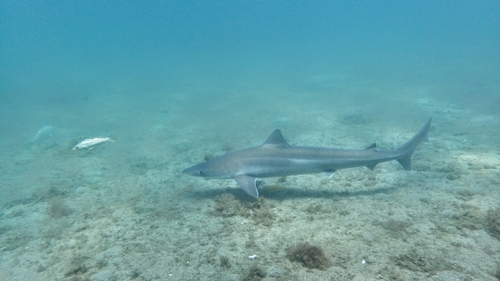
School Shark
Galeorhinus galeus
A sleek, bronze-hued wanderer of the temperate seas, the School Shark is one of the ocean's most impressive long-distance travelers. This critically endangered houndshark is a testament to the beauty and vulnerability of our global marine ecosystems.
Quick Identification
Size
Typically 1.2 to 1.8 meters (4 to 6 feet) in length; weighing up to 35 kg (77 lbs).
Colors
Bronze to greyish-brown on the back with a distinct pale or white underbelly; juveniles may have dark markings on the fins.
Key Features
- Long, translucent snout with a slender profile
- Large, notched terminal lobe on the caudal (tail) fin
- Second dorsal fin is significantly smaller than the first and sits directly above the anal fin
When You’ll See Them
Geographic range
Where Does the School Shark Live?
The School Shark is a cosmopolitan species found in temperate waters across the globe. It is native to the Atlantic, Pacific, and Indian Oceans, with core populations concentrated around the coasts of Australia, New Zealand, South Africa, and the Mediterranean Sea. In the Western Hemisphere, they are frequently sighted from British Columbia down to Peru, and along the southern coasts of South America including Brazil and Argentina. This wide distribution is fragmented, as the species avoids the warm tropical waters near the equator.
Basemap © OpenStreetMap contributors
Behavior
The School Shark is a highly migratory and social species, often found in large, sex-segregated schools. These sharks are known for their impressive endurance, with some tagged individuals traveling over 1,000 miles across open ocean. They spend much of their time near the continental shelf, moving between deep offshore waters and shallow coastal nurseries depending on the season and their life stage.
While they are formidable predators of smaller fish, they are generally shy and non-aggressive toward humans. Their behavior is heavily influenced by water temperature and prey availability. Unfortunately, their slow growth rate and late maturity make them extremely sensitive to human activity, leading to their current status as a protected species in many regions.
EverydayEarth exclusive
Camera Tips
To capture a School Shark on camera, you will need a specialized Baited Remote Underwater Video (BRUV) setup. These sharks are highly attracted to scent, so using a perforated bait canister filled with oily fish like sardines or mackerel is the best way to bring them into frame. Position your camera near the seafloor along rocky reef edges or sandy channels where the sharks are likely to patrol for food.
For the best results, use a wide-angle lens to accommodate their nearly 2-meter length and set your camera to record at 60fps. This higher frame rate will allow you to capture their smooth, serpentine swimming motion in high detail. Since School Sharks are often cautious, ensure your camera housing is camouflaged or non-reflective to avoid spooking them as they approach the bait.
Lighting is a critical factor in underwater shark photography. During the day, natural sunlight is usually sufficient in shallower waters (under 20 meters), but at dusk or in deeper sets, you should use red-spectrum LED lights. Sharks have difficulty seeing red light, which allows you to illuminate the scene without altering their natural hunting behavior. Always check the tide charts; the best footage is often captured during an incoming tide when clear, nutrient-rich water moves toward the coast.
Similar Species
Species that look similar or are commonly confused with School Shark.
Frequently Asked Questions
Record School Shark at your habitat
Connect a camera to start building your own species record — AI identifies every visitor automatically.