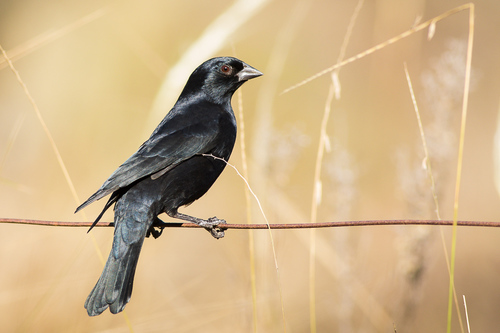
Screaming Cowbird
Molothrus rufoaxillaris
Meet the Screaming Cowbird, a specialized brood parasite of South America known for its piercing calls and unique relationship with the Grayish Baywing. A master of social mimicry, this glossy black bird is a common sight in pastures and gardens alike.
Quick Identification
Size
Length: 18-21 cm (7-8 in); Weight: 40-60 g (1.4-2.1 oz)
Colors
Uniformly black with a silky sheen; both sexes appear identical. Subtle rufous (reddish-brown) patches are hidden on the underwing coverts.
Key Features
- Short, thick bill with a slightly curved culmen
- Uniformly black plumage in both males and females
- Piercing, metallic screeching calls
- Dark brown to reddish-brown eyes
- Squared-off tail shape
When You’ll See Them
Geographic range
Where Does the Screaming Cowbird Live?
The Screaming Cowbird is a native resident of South America, primarily concentrated in the Southern Cone and central regions of the continent. Its core range spans the vast grasslands and scrublands of northern and central Argentina, Uruguay, and Paraguay. It is also commonly found in the southern reaches of Brazil and parts of southeastern Bolivia, where it thrives in landscapes that balance open foraging ground with enough tree cover for its host species to nest.
Basemap © OpenStreetMap contributors
Behavior
The Screaming Cowbird is a fascinating obligate brood parasite, a lifestyle where it entirely avoids the duties of nest-building and chick-rearing. Instead, it specializes in laying its eggs in the nests of other birds, most notably the Grayish Baywing. This specialist relationship is so refined that the young cowbird chicks have evolved to mimic the appearance and calls of the host's own chicks to ensure they are fed and protected. Unlike many other cowbirds that are generalists, the Screaming Cowbird's life cycle is intricately tied to its primary host species.
In social settings, these birds are highly gregarious and can often be found in small flocks, sometimes mixing with other blackbird species. They are frequently observed following cattle or other large mammals in pastures, expertly snatching up insects that are flushed out of the grass. They are bold and vocal birds; their common name is derived from their loud, high-pitched, and often discordant vocalizations that can dominate the morning soundscape in their native habitats.
EverydayEarth exclusive
Camera Tips
To successfully capture a Screaming Cowbird on your backyard AI camera, focus your efforts on ground-level placements. These birds are frequent ground foragers, so placing your camera approximately 12 to 18 inches off the ground near a consistent food source will provide the best angle for identification. Setting up near a low-profile bird bath or a flat tray feeder stocked with white millet or cracked corn is highly effective. Ensure your camera is positioned to capture the profile of the bird, as the short, thick bill is a vital field mark that distinguishes it from its cousins.
Timing and audio are your best friends when targeting this species. Screaming Cowbirds are most active and vocal in the first few hours after sunrise. If your camera supports video with audio recording, make sure it is enabled; their unmistakable metallic shrieks often precede their arrival on camera, giving the AI more data to trigger an alert. During the Southern Hemisphere's spring and summer, try to place your camera near known nesting sites of the Grayish Baywing, as you may witness the adult cowbirds scouting host nests or the fledglings being fed by their foster parents.
For those using trail cameras in more rural or agricultural settings, look for 'hotspots' near livestock. Screaming Cowbirds have a commensal relationship with cattle, often perching on their backs or hopping near their hooves to catch insects. A camera mounted on a fence post near a cattle trough or a salt lick can produce incredible action shots. Use a high trigger speed and a multi-shot burst mode, as these birds move quickly when chasing insects and can be easily missed by slower sensors.
Similar Species
Species that look similar or are commonly confused with Screaming Cowbird.
Shiny Cowbird
Males have a purplish-blue gloss and longer bills, while females are grayish-brown; Screaming Cowbirds are all-black in both sexes.
Grayish Baywing
The primary host of the Screaming Cowbird, this bird is gray-brown with prominent rufous wing patches, unlike the solid black cowbird.
Austral Blackbird
A larger bird with a much longer, more pointed bill and a longer tail compared to the compact Screaming Cowbird.
Frequently Asked Questions
Record Screaming Cowbird at your habitat
Connect a camera to start building your own species record — AI identifies every visitor automatically.