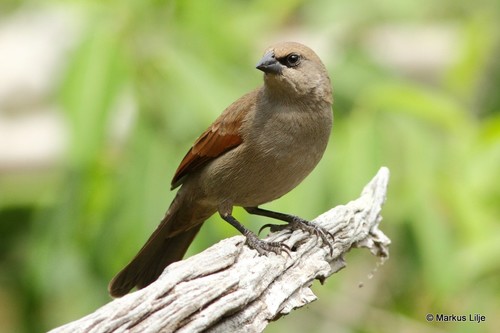
Grayish Baywing
Agelaioides badius
A social and sophisticated songbird of the South American scrub, the Grayish Baywing is famous for its cinnamon-streaked wings and its unique communal lifestyle.
Quick Identification
Size
7-8 inches (18-20 cm) in length; weighs approximately 1.4-1.8 oz (40-50 g)
Colors
Soft ash-gray to brownish-grey body with contrasting bright cinnamon-rufous wing patches and a small black mask around the eyes
Key Features
- Distinctive cinnamon-colored wing feathers visible in flight
- Small black patch (mask) between the eye and the bill
- Thick, conical dark-grey bill
- Highly social behavior, usually appearing in small flocks
When You’ll See Them
Geographic range
Where Does the Grayish Baywing Live?
The Grayish Baywing is a quintessential resident of South America's southern cone and central interior. Its native range spans the vast plains and scrublands of northern Argentina, Uruguay, and Paraguay, extending northward into the dry forests of Bolivia and the central-southern regions of Brazil. This species is highly sedentary, meaning it typically stays in the same region year-round, making it a reliable visitor for backyard enthusiasts within its territory.
Basemap © OpenStreetMap contributors
Behavior
Grayish Baywings are remarkably social and vocal birds, frequently found in noisy, active groups of six to twelve individuals. Unlike many of their relatives in the Icterid family, they are not brood parasites. Instead, they are diligent parents that either build their own cup-shaped nests or, more commonly, refurbish the abandoned mud nests of Rufous Horneros. This social bond extends to their foraging, where the group moves together across the ground or through low shrubbery.
They are known for their complex vocalizations, which include a variety of chirps, whistles, and a distinctive 'churr' call used to keep the flock together. In suburban environments, they adapt well to human presence and are often seen hopping across lawns or visiting garden feeders. Interestingly, they are the primary host for the Screaming Cowbird, which has evolved to mimic the Baywing's appearance almost perfectly to sneak its eggs into their nests.
EverydayEarth exclusive
Camera Tips
To capture high-quality footage of Grayish Baywings, place your AI-powered camera near low-level feeding stations or natural perches about 3 to 5 feet off the ground. These birds are frequent ground-foragers, so a wide-angle view of a flat, grassy area or a tray feeder stocked with small grains and millet will yield the best results. Because they travel in social groups, ensure your camera's 'cool-down' period is set to a minimum; this allows you to record the fascinating interactions between multiple birds as they feed together.
Water is a powerful magnet for this species. A shallow bird bath with a dripper or a small fountain will attract them for both drinking and social bathing, especially during the warmer midday hours. Position the camera so it faces away from the direct sun to avoid glare on the water, focusing on the edge of the bath where the birds typically land before hopping in.
For the best activity, set your recording schedule to capture the early morning hours, roughly an hour after sunrise, when the group is most vocal and active. If you are using a trail camera in a more wild setting, look for transitional areas between thick scrub and open grass. The Grayish Baywing loves these edges, using the scrub for cover and the grass for foraging. A fast trigger speed is essential, as their movements while feeding are quick and jerky.
Similar Species
Species that look similar or are commonly confused with Grayish Baywing.
Screaming Cowbird
Almost identical mimic, but lacks the bright cinnamon wing patches and has a slightly different, more high-pitched call.
Pale Baywing
Found in NE Brazil; has significantly paler, more washed-out plumage compared to the Grayish Baywing.
Shiny Cowbird
Males are iridescent black/purple, while females are duller brown; they lack the cinnamon wings and black mask of the Baywing.
Frequently Asked Questions
Record Grayish Baywing at your habitat
Connect a camera to start building your own species record — AI identifies every visitor automatically.