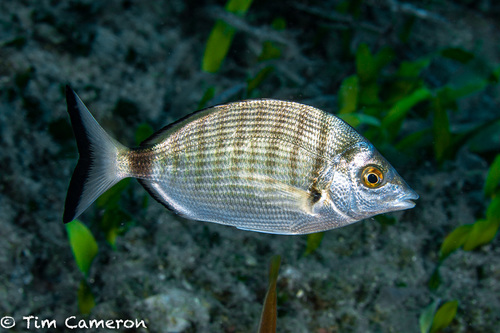
Sharpsnout Seabream
Diplodus puntazzo
With its strikingly pointed profile and elegant silver stripes, the Sharpsnout Seabream is a master of the rocky surf. This inquisitive forager is a favorite find for coastal observers across the Mediterranean and Eastern Atlantic.
Quick Identification
Size
Typically 25–30 cm (10–12 in) in length, though they can grow up to 60 cm (24 in) and weigh nearly 1.7 kg (3.7 lbs).
Colors
Silver-grey body with 7 to 11 narrow, vertical dark bands; a prominent black saddle-shaped spot at the base of the tail; fins often have a dusky or yellowish tint.
Key Features
- Distinctly pointed, elongated snout
- 7-11 thin vertical black bars on the flanks
- Black spot on the caudal peduncle (tail base)
- Silver iridescent scales
- Slightly protruding front teeth
When You’ll See Them
Geographic range
Where Does the Sharpsnout Seabream Live?
The Sharpsnout Seabream is native to the temperate and subtropical coastal waters of the Eastern Atlantic Ocean and the Mediterranean basin. Its range spans from the Bay of Biscay in the north, continuing south along the African coastline as far as Sierra Leone, including the offshore islands of the Canaries and Madeira. It is also a permanent resident throughout the entirety of the Mediterranean and Black Seas, where it thrives in the shallow, oxygen-rich waters of rocky coastlines.
Basemap © OpenStreetMap contributors
Behavior
The Sharpsnout Seabream is an active and curious fish often seen patrolling the turbulent waters of the rocky surf zone. Unlike many other members of the Sparidae family, which can be shy and reclusive, this species is relatively bold and frequently approaches divers or underwater cameras to investigate its surroundings. They are primarily diurnal, meaning they are most active during the day when they can use their keen eyesight to forage along the seabed.
Socially, the Sharpsnout Seabream exhibits different patterns based on age. Juveniles are highly social and tend to congregate in large, protective schools in shallow lagoons or estuaries. As they mature into adults, they become more solitary or form small, loose groups. They are known for their specific swimming style, often pausing to 'hover' as they pick at algae or small invertebrates with their specialized snouts.
EverydayEarth exclusive
Camera Tips
Capturing the Sharpsnout Seabream requires an underwater setup, ideally positioned in the 'wash zone' where waves break against rocky shorelines. This is their primary feeding ground. Use a weighted tripod or a suction mount to secure your camera housing to a flat rock surface at a depth of 1 to 3 meters. To get the best clarity, orient the camera so the sun is behind it, which will illuminate the fish's silver scales and make the vertical black bars stand out against the blue water.
Because these fish are naturally inquisitive, they are easily attracted to bait. A 'chum cage' or a mesh bag filled with crushed mollusks or sea urchins placed just outside the camera's field of view will draw them in and keep them hovering in front of the lens. This species is faster than it looks, so set your camera to a high frame rate (at least 60fps) to avoid motion blur during their quick darting movements.
Timing is everything when filming coastal fish. The best results are achieved on days with low swell and high water clarity (visibility over 5 meters). Mid-morning is the ideal time, as the sun is high enough to penetrate the water but not so overhead that it creates harsh reflections on the fish’s metallic skin. If your camera supports it, using a light red or magenta filter can help restore the natural colors that are often lost underwater, ensuring the Sharpsnout Seabream looks as vibrant on screen as it does in the wild.
Similar Species
Species that look similar or are commonly confused with Sharpsnout Seabream.
Frequently Asked Questions
Record Sharpsnout Seabream at your habitat
Connect a camera to start building your own species record — AI identifies every visitor automatically.