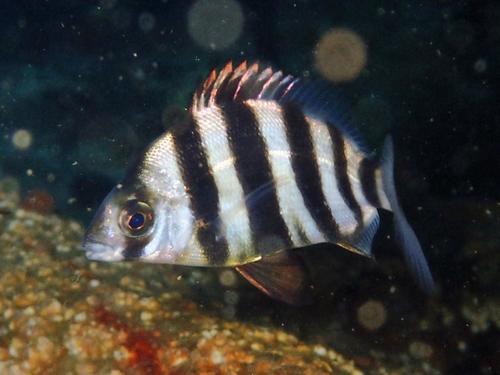
Zebra Seabream
Diplodus hottentotus
With its bold vertical stripes and inquisitive personality, the Zebra Seabream is the striking 'zebra of the sea' that brings life to rocky southern coastlines.
Quick Identification
Size
Typically 30-45 cm (12-18 in), reaching a maximum length of 60 cm (24 in); weight up to 6 kg (13 lbs).
Colors
Brilliant silver body marked by 5-6 broad, dark vertical bars; fins are generally greyish-black with thick, pale fleshy lips.
Key Features
- 5-6 wide dark vertical bands on a silver body
- Thick, prominent fleshy lips
- Deep, compressed body shape
- Small dark spot at the pectoral fin base
When You’ll See Them
Geographic range
Where Does the Zebra Seabream Live?
The Zebra Seabream is a cornerstone species of the southern African coastline. Its primary range extends from the temperate waters of Angola and Namibia, wrapping around the entire South African coast, and reaching as far north as southern Mozambique. It thrives in the transition zone where the Atlantic and Indian Oceans meet, favoring the nutrient-dense rocky shelves of the Cape.
Basemap © OpenStreetMap contributors
Behavior
The Zebra Seabream is a social and inquisitive species often found in small shoals ranging from five to twenty individuals. While adults prefer the turbulent waters of rocky reefs and the surf zone, juveniles are commonly found in the calmer environments of intertidal rock pools and estuaries. They are known for their 'grazing' behavior, where they move methodically across submerged rocks, using their specialized teeth to pluck prey from the substrate.
In the presence of humans, such as snorkelers or divers, they exhibit a curious but cautious temperament. They are not easily spooked compared to other seabreams and will often approach an observer if they remain still. In 'backyard' coastal settings like private piers or rock walls, they are highly territorial and can be seen defending specific foraging patches from smaller competitors.
EverydayEarth exclusive
Camera Tips
Capturing the Zebra Seabream requires an underwater action camera (like a GoPro) or a specialized waterproof trail camera. For the best results in a coastal 'backyard' or tide pool, use a weighted tripod or a lead-weighted camera housing to prevent the surge of the tide from moving your equipment. Position the camera at a slight upward angle toward a sunlit patch of rocky reef, as the sunlight will make their silver scales pop against the dark bands.
To attract these fish to your lens, use a 'scent trail' rather than loose food. A mesh bag filled with crushed mussels or sea urchins tied to a nearby rock works wonders. The Zebra Seabream's curious nature will lead them to investigate the source of the smell within minutes. Ensure your camera is set to a high frame rate (60fps or higher) to capture their quick, darting movements as they nip at the bait.
Timing is everything when filming in the surf. Aim for the 'slack tide'—the hour before and after high tide—when the water is clearest and the sediment has settled. If you are placing a camera in a rock pool, do so during a rising tide when fresh, oxygenated water brings these fish in from the deeper reef. Avoid murky water days, as the autofocus on many cameras struggles with the high-contrast stripes of the fish in low visibility.
Similar Species
Species that look similar or are commonly confused with Zebra Seabream.
Two-banded Seabream
Has only two dark vertical bands—one behind the head and one at the tail base—rather than stripes across the whole body.
White Stumpnose
Lacks the broad dark bars and instead has very faint, thin golden vertical lines and a more pointed snout.
Galjoen
Has a darker, more uniform grey-to-black color and can change shade to match rocks, lacking the permanent high-contrast silver and black stripes.
Frequently Asked Questions
Record Zebra Seabream at your habitat
Connect a camera to start building your own species record — AI identifies every visitor automatically.