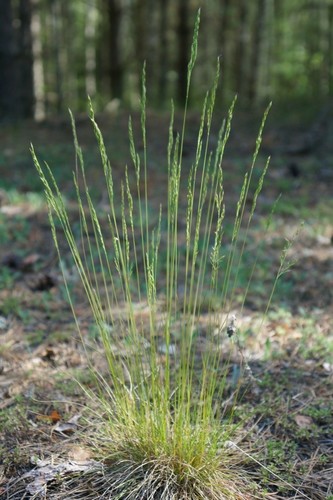
Sheep's Fescue
Festuca ovina
A resilient, fine-textured bunchgrass that transforms dry landscapes into shimmering blue-green meadows. Sheep's Fescue is the ultimate low-maintenance beauty, providing essential habitat for the smallest of backyard creatures.
Quick Identification
Size
Grows 10–40 cm (4–16 inches) tall, with flower spikes reaching up to 60 cm (24 inches).
Colors
Blue-green to grayish-green foliage; flower heads are initially green or purplish, maturing to a light straw-yellow.
Key Features
- Fine, needle-like leaves that are rolled or folded
- Distinctive densely tufted growth habit (clump-forming)
- Short, blunt ligules and no auricles at the leaf base
- Seed heads consist of a one-sided panicle with short branches
When You’ll See Them
Behavior
Sheep's Fescue is a hardy, perennial bunchgrass known for its remarkable resilience and ability to thrive where other plants fail. Unlike many lawn grasses that spread via underground runners (rhizomes), this species grows in tight, architectural clumps. It is a slow-growing plant that prioritizes deep root development, making it exceptionally drought-tolerant and capable of surviving in nutrient-poor, acidic soils.
In a backyard setting, Sheep's Fescue acts as a foundational species for biodiversity. It provides essential cover for ground-dwelling insects and spiders, which in turn attract birds. While it doesn't 'behave' in the traditional sense, its seasonal transition—from lush blue-green tufts in the spring to tall, golden seed heads in the summer—provides a shifting backdrop for local wildlife activity. It is often used in 'no-mow' meadow mixes because it remains short and tidy without human intervention.
EverydayEarth exclusive
Camera Tips
To capture the subtle beauty of Sheep's Fescue on a trail camera, you need to think like a macro photographer. Because the grass is relatively short, mount your camera on a ground stake or a very low tripod, positioned only 6 to 12 inches off the ground. Aiming the lens slightly upward toward the seed heads can create a dramatic 'forest of grass' perspective that highlights the texture of the leaves against the sky.
For the best visual results, utilize the time-lapse mode on your camera. Setting the camera to take one photo every 30 minutes during daylight hours over a period of several weeks will allow you to see the grass 'breathe' as it reacts to moisture and sunlight. This is particularly effective during the late spring when the flower spikes emerge and bloom. If your camera has a close-focus or macro setting, use it to capture the intricate details of the dew-covered blades in the early morning.
Lighting is critical for this species. Position your camera so that it is 'backlit' during the golden hours—early morning or late afternoon. The sun shining through the fine, translucent leaves and seed heads creates a glowing effect that makes the grass pop against a darker background. If you are trying to capture the wildlife that uses the grass as cover, place a small amount of birdseed or a water source nearby to encourage birds like sparrows to land among the tufts.
Lastly, consider the weather. Sheep's Fescue is incredibly expressive in the wind and frost. If a cold snap is forecasted, ensure your camera is positioned to catch the morning frost on the needle-like leaves. The high surface area of the fine blades makes them perfect for catching ice crystals, resulting in stunning, high-contrast imagery that stands out in any backyard wildlife gallery.
Similar Species
Species that look similar or are commonly confused with Sheep's Fescue.
Frequently Asked Questions
Record Sheep's Fescue at your habitat
Connect a camera to start building your own species record — AI identifies every visitor automatically.