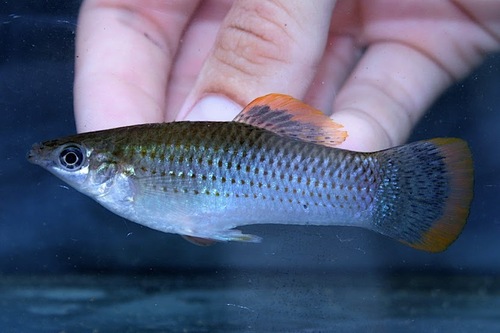
Shortfin Molly
Poecilia mexicana
A resilient gem of Central American waterways, the Shortfin Molly is famous for its ability to thrive in everything from sun-drenched lagoons to the deepest, darkest caves.
Quick Identification
Size
4–10 cm (1.5–4 inches) in length; females are notably larger and more robust than the slender males.
Colors
Dull olive to brownish-grey with a silvery iridescence; males often feature yellow or orange borders on their dorsal and tail fins and may show dark spotting.
Key Features
- Upturned mouth adapted for surface feeding
- Short, rounded dorsal fin positioned behind the midpoint of the body
- Males possess a rod-like modified anal fin called a gonopodium
- Compact, slightly compressed body shape.
When You’ll See Them
Geographic range
Where Does the Shortfin Molly Live?
The Shortfin Molly is a quintessential species of the Atlantic slope of Middle America. It is natively found across a broad stretch of the neotropics, beginning in northeastern Mexico and extending south through Guatemala, Belize, Honduras, Nicaragua, and Costa Rica, all the way to Panama. Because of its popularity in the aquarium trade, small localized populations have occasionally been introduced to other tropical regions, but its heartland remains the coastal and inland waterways of Central America.
Basemap © OpenStreetMap contributors
Behavior
Shortfin Mollies are highly social and energetic fish that spend much of their day in small to medium-sized schools. They are incredibly adaptable, capable of thriving in environments ranging from freshwater springs to brackish coastal lagoons. In the wild, they are active foragers, constantly nipping at submerged surfaces to graze on algae and microscopic organisms. This constant movement makes them a dynamic species to observe in any aquatic setting.
As live-bearers, their reproductive behavior is a central part of their social structure. Males are frequently seen performing courtship displays or following females closely. Interestingly, some populations have adapted to extreme environments, such as sulfur-rich springs or pitch-black limestone caves, demonstrating an extraordinary level of evolutionary resilience. While they are generally shy around large disturbances, they quickly habituate to human presence if they associate it with food sources.
EverydayEarth exclusive
Camera Tips
Capturing high-quality footage of the Shortfin Molly requires an underwater setup, as traditional trail cameras will only capture surface ripples. Use an action camera with a waterproof housing or a specialized underwater trail camera. Position the lens about 10–20 centimeters below the surface, facing a patch of sunlit algae or a submerged rock, as this is where the fish are most likely to congregate to feed. An angled placement—roughly 45 degrees toward the water's surface—often captures the best play of light on their iridescent scales.
To attract a school into the frame, you can use 'baiting' techniques that mimic their natural food. Sinking algae wafers or a small amount of fish food placed inside a mesh bag can keep the mollies in the camera’s field of view for extended periods. If you are filming in a backyard pond, ensure your camera is set to a high frame rate (at least 60fps), as these fish move with sudden, darting bursts that can appear blurry on lower settings.
Lighting is the most critical factor for these fish. Unlike mammals that are best captured at dawn or dusk, mollies look their best in the middle of the day when the sun is directly overhead. This light penetrates the water column and reveals the subtle blues and greens in their scales. During the rainy season, water clarity may drop, so the best footage is typically captured during the drier months when the water is crystal clear and the fish are more concentrated in permanent pools.
Similar Species
Species that look similar or are commonly confused with Shortfin Molly.
Sailfin Molly
The Sailfin Molly has a significantly larger, more ornate dorsal fin with 12-14 rays, compared to the 8-11 rays of the Shortfin Molly.
Amazon Molly
A unique all-female species that is a hybrid of the Shortfin Molly; they are nearly identical but lack the distinct male coloration and gonopodium.
Frequently Asked Questions
Record Shortfin Molly at your habitat
Connect a camera to start building your own species record — AI identifies every visitor automatically.