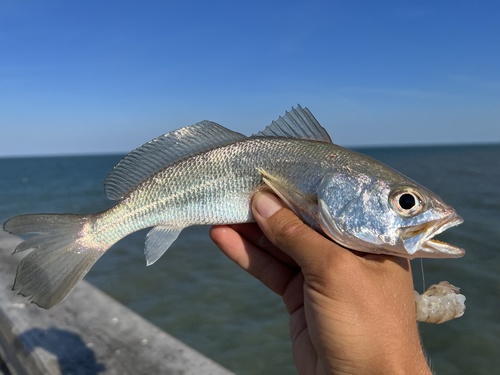
Silver Weakfish
Cynoscion nothus
The Silver Weakfish is the 'ghost of the estuary,' a shimmering, drum-beating predator that haunts coastal docks and sandy bays. Discover the secrets of this elusive silver hunter.
Quick Identification
Size
Typically 8-12 inches (20-30 cm) in length; can reach up to 15 inches (38 cm). Weight is usually 0.5-1.5 lbs (0.2-0.7 kg).
Colors
Bright shimmering silver throughout the body with a pale, iridescent grayish-blue back. The belly is pure white, and unlike its relatives, it lacks any distinct dark spots or markings.
Key Features
- Slender, compressed body shape
- Lower jaw protrudes noticeably beyond the upper jaw
- Lack of dark spots on the body or fins
- Two large, canine-like teeth in the front of the upper jaw
When You’ll See Them
Behavior
Silver Weakfish, often called Silver Seatrout, are highly social fish that travel in large, coordinated schools. They are primarily found in coastal waters and estuaries, moving with the tides to exploit changing food sources. They get the name 'weakfish' not because of their strength, but because of the fragile, thin membranes in their mouths which easily tear when they encounter a hook.
As members of the drum family, Silver Weakfish are famous for their ability to produce sound. Male fish use specialized muscles to vibrate their swim bladders, creating a distinct drumming or croaking noise used to attract mates during the spawning season. While they are generally shy and easily spooked by heavy boat traffic, they are curious enough to congregate around dock lights at night to hunt for disoriented prey.
EverydayEarth exclusive
Camera Tips
To capture Silver Weakfish on an EverydayEarth setup, you will need a waterproof underwater camera housing. The most effective placement is mounting the camera to a dock piling or a weighted tripod set 2-4 feet off the seafloor in a coastal canal or bay. Position the lens to face the current; these fish often hover facing into the flow, waiting for the tide to wash small shrimp and baitfish toward them.
Lighting is your best friend when documenting this species. Silver Weakfish are highly attracted to 'green' underwater fishing lights. By installing a submersible light near your camera, you create an entire ecosystem in the frame: the light attracts plankton, which attracts shrimp, which eventually draws in the Silver Weakfish. Set your camera to record in high frame rates (60fps or higher) because their strike on prey is lightning-fast and can appear as a mere silver blur on standard settings.
Because their scales are highly reflective, avoid using high-intensity direct white light, which can cause 'blowout' in your footage where the fish appears as a featureless white shape. Instead, use ambient light or diffused LEDs. If you are placing a camera in a 'backyard' canal, try to time your recording sessions with the incoming tide, as the water clarity is usually much higher, allowing for the crisp, clear shots that highlight their iridescent silver sheen.
Similar Species
Species that look similar or are commonly confused with Silver Weakfish.
Frequently Asked Questions
Record Silver Weakfish at your habitat
Connect a camera to start building your own species record — AI identifies every visitor automatically.