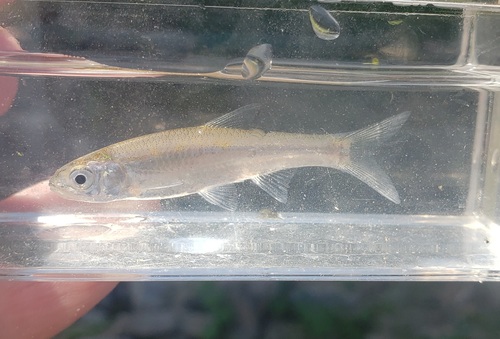
Silverband Shiner
Paranotropis shumardi
A shimmering jewel of the Mississippi, the Silverband Shiner is a master of the deep river current. With its brilliant metallic stripe and large, curious eyes, this hardy minnow brings a flash of silver to the heart of America's great waterways.
Quick Identification
Size
5 to 10 cm (2 to 4 inches) in length; typically weighs less than 15 grams (0.5 oz)
Colors
Brilliant metallic silver sides with a pale olive or yellowish back; fins are translucent or clear with no distinct spots
Key Features
- Distinct bright silver lateral band along the sides
- Large eyes relative to head size
- Streamlined, slightly compressed body shape
- Terminal mouth positioned at the front of the snout
When You’ll See Them
Geographic range
Where Does the Silverband Shiner Live?
Native to the expansive freshwater systems of North America, the Silverband Shiner is primarily found throughout the Mississippi River basin. Its core range extends from the northern reaches of South Dakota and Illinois, flowing southward through the central United States into Arkansas and Louisiana, and reaches several Gulf slope drainages. While it is a specialist of the great river systems like the Missouri and Ohio, it is rarely found in isolated upland streams or landlocked lakes.
Basemap © OpenStreetMap contributors
Behavior
The Silverband Shiner is a social, schooling fish that thrives in the moving waters of large river systems. Unlike many smaller minnows that prefer stagnant pools, this species is specifically adapted to the main channels and deep chutes of major rivers where the current is steady. They are active swimmers, often found moving in synchronized groups to confuse predators and increase foraging efficiency.
In terms of social hierarchy, they do not exhibit strong territoriality but rely heavily on the safety of the school. They are drift feeders, meaning they frequently position themselves in the current to intercept food particles floating downstream. While they are generally shy and will dart away from sudden movements, they are essential members of the river ecosystem, serving as a primary food source for larger game fish like bass and catfish.
EverydayEarth exclusive
Camera Tips
Capturing the Silverband Shiner requires a specialized underwater approach, as this species rarely nears the surface of shallow backyard ponds. If you live near a large river tributary, use a waterproof action camera or a dedicated underwater trail camera. Position the lens at a 45-degree angle to the riverbed in a relatively clear side-channel or 'chute' where the water slows down. Because these fish have highly reflective scales, avoid direct midday sun which can cause 'white-out' glare on the silver band; early morning or late afternoon light provides the best color saturation.
To draw a school into the frame, use a fine-mesh bait bag filled with crushed fish flakes or breadcrumbs. Secure the bag to a heavy rock just upstream of your camera's field of view. The scent trail will encourage the shiners to linger in front of the lens. Since they are fast-moving schooling fish, set your camera to its highest possible frame rate—ideally 60fps or higher—to capture their fluid motion without motion blur.
Be mindful of water turbidity. The Silverband Shiner actually prefers somewhat 'cloudy' water, which can make photography difficult. To combat this, place your camera as close to your 'bait station' as possible (within 12-18 inches) to minimize the amount of suspended sediment between the lens and the fish. If your camera has a 'macro' or close-focus setting, ensure it is engaged to capture the fine details of their metallic scales and large eyes.
Similar Species
Species that look similar or are commonly confused with Silverband Shiner.
Emerald Shiner
Slenderer, more elongated body with a less distinct silver band and a more translucent, greenish back.
Sand Shiner
Smaller eyes and a distinct 'mid-dorsal' stripe that the Silverband Shiner lacks.
River Shiner
Lacks the brilliant metallic silver lateral band and generally has a more blunt snout.
Frequently Asked Questions
Record Silverband Shiner at your habitat
Connect a camera to start building your own species record — AI identifies every visitor automatically.