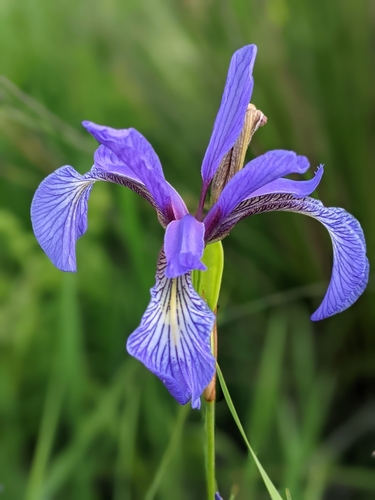
Slender Blue Flag
Iris prismatica
Elegant and airy, the Slender Blue Flag is the 'quiet cousin' of the iris world. With its grass-like leaves and stunning violet-veined petals, it turns any damp corner of a yard into a sophisticated wetland sanctuary.
Quick Identification
Size
Stems reach 12–32 inches (30–80 cm) in height; leaves are exceptionally narrow, typically 0.1–0.2 inches (2–5 mm) wide.
Colors
Pale blue to deep violet petals; sepals feature a prominent white and yellow 'signal' patch with intricate dark purple veins.
Key Features
- Extremely narrow, grass-like foliage
- Slender, solid stems that are usually unbranched
- Distinctive cuboid or prismatic seeds
- Delicate blossoms roughly 2.5–3 inches across
When You’ll See Them
Behavior
The Slender Blue Flag is a graceful, clump-forming perennial that behaves much like a quiet resident of the wetlands. Unlike the more aggressive Larger Blue Flag, this species spreads slowly through thin, wiry rhizomes, forming elegant clusters that blend seamlessly with marsh grasses and sedges. It is a hardy survivor, capable of handling both brackish water and occasional flooding, making it a vital component of coastal and meadow ecosystems.
During its blooming period in late spring and early summer, the plant becomes a hub of activity for local pollinators. It specifically caters to long-tongued bees, such as bumblebees, which are strong enough to push through the floral parts to reach the nectar. While it doesn't move in the traditional sense, its slender stems sway beautifully in the breeze, and its floral structure is perfectly engineered to ensure cross-pollination by visiting insects.
EverydayEarth exclusive
Camera Tips
Capturing the Slender Blue Flag requires a focus on stability and lighting. Because this plant has exceptionally thin stems, even a light breeze can cause significant motion blur. For the best results on a trail camera or backyard setup, use a fast shutter speed or place the camera on a short tripod or ground mount. If you are using a triggered AI camera, try to position it within 2-3 feet of the plant to capture the intricate purple veining on the 'falls' (the downward-pointing sepals).
Lighting is your best friend with this species. To get that 'professional' look, aim for backlighting during the golden hour (just after sunrise or before sunset). The thin petals of the Iris prismatica are somewhat translucent; when the sun hits them from behind, the violet hues glow brilliantly, and the delicate veins become highly visible. If your camera allows for it, a macro setting or lens is ideal for showcasing the yellow 'signal' patch that guides bees into the flower.
For a unique perspective, set your camera to time-lapse mode during the peak blooming month of June. Program the camera to take a photo every 15-30 minutes from dawn until dusk. This allows you to witness the dramatic 'unfurling' of the bloom, which often happens quite quickly. Additionally, since these plants grow in wet areas, ensure your equipment is waterproof or elevated slightly above the mud line to avoid moisture damage to the sensor.
Finally, consider the background. Because the Slender Blue Flag has such thin, grass-like leaves, it can easily get 'lost' in a photo of a green field. Try to angle your camera so there is a contrasting background—like a dark pond or a shaded wooded edge—behind the flower. This contrast will help the slender silhouette of the iris pop in your photos, making it easier for AI software to identify the species correctly.
Similar Species
Species that look similar or are commonly confused with Slender Blue Flag.
Frequently Asked Questions
Record Slender Blue Flag at your habitat
Connect a camera to start building your own species record — AI identifies every visitor automatically.