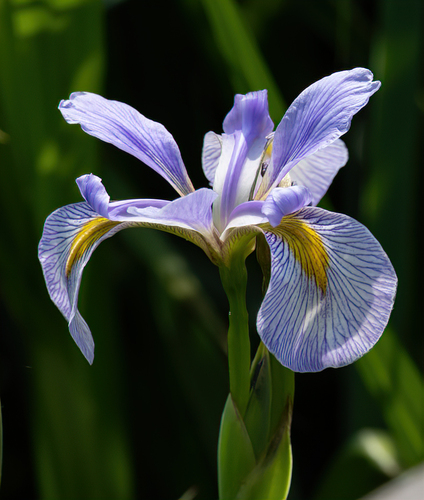
southern blue flag
Iris virginica
A regal native beauty that transforms wet backyard corners into violet-hued sanctuaries for hummingbirds and bees. With its striking yellow-crested petals and tall, architectural leaves, the southern blue flag is the crown jewel of the North American marsh.
Quick Identification
Size
Stands 60–90 cm (2–3 ft) tall with sword-shaped leaves roughly 1–3 cm (0.4–1.2 in) wide.
Colors
Violet-blue to lavender petals; outer petals (falls) feature a prominent bright yellow, fuzzy patch at the base.
Key Features
- Three drooping 'falls' with yellow crests
- Three upright 'standards'
- Sword-shaped, slightly arching green leaves
- Clumping growth habit from thick rhizomes
When You’ll See Them
Behavior
The southern blue flag is a hardy perennial that brings structural elegance to wet landscapes. Unlike many garden irises, this species thrives with its 'feet' wet, often forming dense, lush colonies through its underground rhizome system. It acts as a vital early-season nectar source, specifically evolved to accommodate the weight of large bees and the hovering precision of hummingbirds.
In the backyard ecosystem, these plants are more than just ornamentals; they serve as a miniature hub of activity. During the late spring bloom, you will observe a complex 'landing pad' system where pollinators follow dark violet veins—nectar guides—straight to the center of the flower. After the blooming period, the plant transitions into a structural role, providing cover for small amphibians and dragonflies near water edges.
EverydayEarth exclusive
Camera Tips
Capturing the southern blue flag requires a shift from traditional motion-triggering to time-lapse or high-speed insect photography. Because the plant itself is stationary, the most rewarding use of a backyard camera is to document the 'unfolding' of the bloom. Set your camera to a time-lapse mode, taking one high-resolution photo every 15 to 30 minutes over a three-day period. This will capture the dramatic transition from a tight green bud to a glorious violet explosion.
If you are looking to capture the wildlife that visits the iris, place your camera on a tripod or stake at the same height as the flower head (usually 2-3 feet off the ground). Position the camera about 3-5 feet away to allow for a wide enough field of view to catch incoming hummingbirds. Use a 'Fast' trigger speed or 'Burst Mode' to ensure you don't just get a blur of wings. The yellow 'signal' patches on the falls are the best place to center your focus, as this is exactly where bees will land.
Lighting is critical for this species. The violet petals can easily look 'blown out' or lose their texture in harsh midday sun. Aim to capture your best footage during the 'Golden Hour'—shortly after sunrise or before sunset—when the low-angle light illuminates the translucent petals from behind, making the flower appear to glow. If your camera allows for manual exposure, slightly underexposing the shot can help preserve the deep richness of the purple veins.
Finally, consider the seasonal story. Don't pull your camera once the flowers fade. The large, three-angled seed pods that follow the blooms are fascinating to document as they brown and eventually split open. Positioning a camera low to the ground near the base of the plant can also reveal 'hidden' visitors like frogs or salamanders that utilize the dense shade of the iris leaves during the heat of the summer.
Similar Species
Species that look similar or are commonly confused with southern blue flag.
Frequently Asked Questions
Record southern blue flag at your habitat
Connect a camera to start building your own species record — AI identifies every visitor automatically.