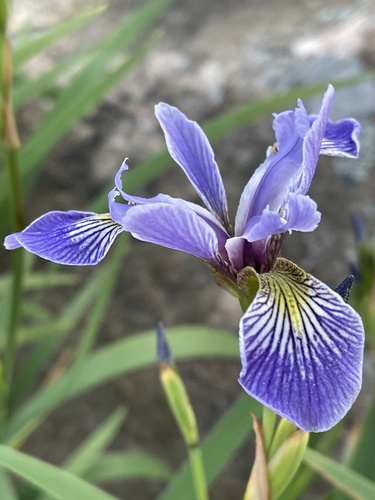
northern blue flag
Iris versicolor
With its striking royal violet blooms and elegant sword-like leaves, the northern blue flag is the crown jewel of the North American wetland. This hardy native perennial not only brightens shorelines but serves as a vital nectar hub for early-summer pollinators.
Quick Identification
Size
Height of 60-90 cm (2-3 ft); spread of 30-60 cm (1-2 ft)
Colors
Deep violet-blue to lavender petals; white and yellow 'signal' patches at the base of the sepals; grayish-green foliage.
Key Features
- Showy 3-4 inch blue-violet blooms with yellow/white signals
- Rigid, sword-shaped grayish-green leaves
- Clumping growth habit from thick rhizomes
- Three upright petals and three drooping sepals
When You’ll See Them
Behavior
The northern blue flag is a stunning wetland perennial that brings a splash of royal color to water edges and damp meadows. Unlike many garden varieties, this species thrives with 'wet feet,' often found growing directly in shallow water. It behaves as a critical early-summer nectar source, using its intricate patterns to guide pollinators into the heart of the flower.
While beautiful to look at, the northern blue flag is also known as the 'poison flag.' Its roots contain iridin, a compound that is toxic to humans and many animals if ingested. In its natural environment, it serves as a functional anchor, helping to stabilize shorelines and filter nutrients from runoff, making it an essential player in wetland health.
EverydayEarth exclusive
Camera Tips
Capturing the northern blue flag with a backyard camera offers a unique opportunity to witness 'pollinator parties.' Instead of traditional motion-triggering used for mammals, set your camera to time-lapse mode during the peak blooming weeks of June. This allows you to create a stunning visual record of the flowers unfurling at dawn and the rhythmic visitations of bumblebees and hummingbirds throughout the day.
For the best framing, place your camera on a low tripod or stake about 2 to 3 feet away from the flower cluster, aiming slightly upward. This 'frog’s-eye view' highlights the intricate yellow and white 'signal' patterns on the sepals which are often lost from a standing height. Ensure the camera is positioned with the sun behind it or to the side; direct midday sun can wash out the deep violet hues, while morning or late afternoon light makes the petals appear to glow.
If you are using a motion-triggered camera, set the sensitivity to high. While the plant itself won't trigger the sensor, the arrival of a heavy bumblebee or the rapid movement of a Ruby-throated Hummingbird will. To get the best shots of these fast-moving visitors, use a fast shutter speed or 'burst' mode settings. These flowers are also excellent subjects for monitoring local climate trends—by keeping a camera on the same patch every year, you can track how spring temperatures affect the exact day the first bloom opens.
Similar Species
Species that look similar or are commonly confused with northern blue flag.
Southern Blue Flag
Very similar, but typically grows taller and has a more prominent, fuzzy yellow patch on the sepals.
Slender Blue Flag
Has much narrower, grass-like leaves and smaller flowers on thinner, wiry stems.
Siberian Iris
A common garden plant with much thinner leaves and smaller flowers that lack the thick, water-loving rhizomes of the native species.
Frequently Asked Questions
Record northern blue flag at your habitat
Connect a camera to start building your own species record — AI identifies every visitor automatically.