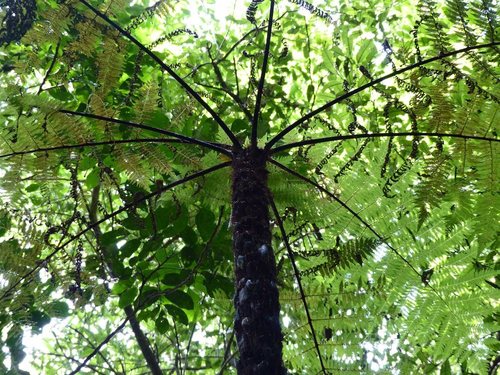
slender tree fern
Cyathea cunninghamii
The slender tree fern is the elegant minimalist of the forest, boasting a towering, pencil-thin trunk topped with a crown of delicate, lacy fronds. A rare find in damp gullies, it is a master of reaching for the light while keeping its feet in the shade.
Quick Identification
Size
Trunk height up to 20m (65ft); trunk diameter 6–15cm (2.4–6in); fronds 3m (10ft) or longer.
Colors
Rich green fronds with dark brown to black stipes (stems); trunk is dark and fibrous with brown scales.
Key Features
- Exceptionally slender trunk compared to height
- Dark brown to blackish warty stipes at the base of fronds
- Tri- to tetrapinnate fronds creating a delicate, lacy appearance
- Hood-like indusia covering the sori (spore clusters)
When You’ll See Them
Behavior
The slender tree fern is a slow-growing, long-lived resident of wet forest ecosystems. Unlike many other tree ferns that can tolerate some sun or wind, this species is highly sensitive to moisture levels and thrives best in the humid, sheltered microclimates of deep gullies. It acts as a vertical anchor in the forest, often growing taller than other fern species to reach filtered light, though it rarely forms a dense canopy, allowing light to reach the plants below.
As it grows, old fronds drop away cleanly, leaving a relatively smooth but fibrous trunk compared to the 'shaggy' appearance of other species. In its reproductive phase, it produces spores on the undersides of its leaves, which are dispersed by the wind. While it doesn't 'behave' in the animal sense, its responsiveness to drought is notable; the fronds will quickly wilt and die back if the water table drops or if it is exposed to drying winds, making it a living barometer for the health of a damp forest patch.
EverydayEarth exclusive
Camera Tips
Capturing the slender tree fern on camera requires a different approach than mobile wildlife. Because of its extreme height and very narrow trunk, a standard horizontal trail camera placement often misses the 'personality' of the plant. If you have one in your backyard or woodlot, try mounting your camera at a slight upward angle (about 15-20 degrees) from a distance of 10-15 feet. This captures the elegant 'slender' profile that gives the species its name, showing the contrast between the thin trunk and the wide, lacy canopy.
The most exciting footage you can capture of a slender tree fern is a long-term timelapse of a new frond, or 'koru,' unfurling. To do this, locate a developing coil at the crown of the fern. Secure your camera to a nearby tree or a tall stake, setting it to take one photo every 4-6 hours. Over several weeks, you will see the dramatic, serpentine movement of the fern reaching upward and expanding its foliage. Ensure your camera is set to a high resolution, as the fine details of the scales and hairs on the stipe are beautiful to see in close-up.
Since these ferns live in dark, damp gullies, lighting can be a challenge. Avoid using heavy flash, which can wash out the deep greens and create harsh shadows against the forest floor. Instead, aim for your camera to trigger during the 'golden hours' of early morning or late afternoon when dappled light filters through the canopy. If your camera has a sensitivity setting, keep it low to avoid false triggers from moving fronds in the wind, focusing instead on scheduled captures or timelapse modes.
Finally, use your camera as a conservation tool. Because the slender tree fern is sensitive to drought, monitoring the angle and color of the fronds through the seasons can tell you a lot about the moisture levels in your local ecosystem. If you notice the fronds drooping significantly or browning at the edges on your weekly check-ins, it may be time to provide some supplementary water to the root zone if the plant is in a managed garden setting.
Similar Species
Species that look similar or are commonly confused with slender tree fern.
Frequently Asked Questions
Record slender tree fern at your habitat
Connect a camera to start building your own species record — AI identifies every visitor automatically.