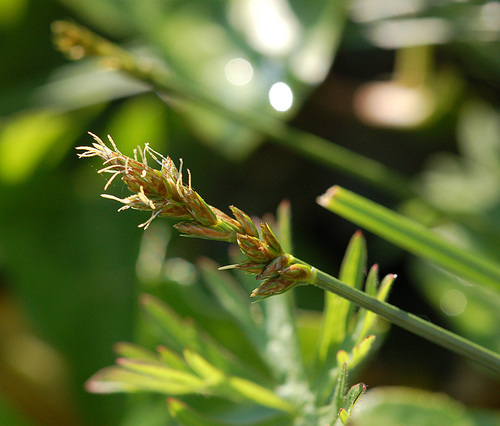
Small-fruited Prickly-sedge
Carex pairae
A hardy, tufted perennial that brings a touch of wild elegance to dry garden spots. Its prickly, star-shaped seed heads are a magnet for local birds and a delight for macro-photography enthusiasts.
Quick Identification
Size
15–40 cm (6–16 inches) tall; leaves 2–3 mm wide
Colors
Bright green foliage; seed heads turn from pale green to golden-brown as they mature
Key Features
- Tight, tufted growth habit (caespitose)
- Star-shaped, prickly seed heads (perigynia)
- Stems are rough to the touch near the top
- Leaf sheaths have a distinct whitish-translucent front
When You’ll See Them
Behavior
As a perennial sedge, the Small-fruited Prickly-sedge spends its life anchored in one spot, growing in dense, tidy clumps. Unlike many grasses that spread via underground runners, this species stays contained in a 'tufted' form, making it a non-invasive addition to a garden or meadow. It is a hardy survivor, often appearing in areas where other plants struggle due to dry or gravelly soil.
Ecologically, this plant plays a quiet but vital role. Its dense base provides a micro-habitat for ground-dwelling invertebrates, such as spiders and beetles, while its prickly seeds are a sought-after food source for small ground-feeding birds during the late summer. It does not demand much from its environment, slowly expanding its clump size each year through its short rhizomes.
EverydayEarth exclusive
Camera Tips
To capture the fine details of the Small-fruited Prickly-sedge, position your camera at a low 'worm's-eye' angle, no more than 6-10 inches from the ground. Because this sedge is relatively short, reaching about 8-15 inches, a standard trail camera mounted on a tree trunk may overshoot it. Instead, use a ground-stake mount or a flexible tripod. If your AI camera has a macro lens attachment or a 'close-focus' setting, this is the perfect subject to use it on, as the intricate star-shaped textures of the seed heads are its most defining feature.
Lighting is crucial for documenting this species effectively. If possible, orient your camera so the sun backlights the plant during the 'golden hours' of early morning or late afternoon. The translucent margins of the perigynia (the seed sacs) will catch the light, creating a beautiful glowing effect that helps the AI software differentiate the sedge from the surrounding flat green grass. To capture the wildlife that interacts with the sedge, such as sparrows or ground-beetles, set your camera to 'Photo + Video' mode with a high trigger sensitivity.
If you are using an AI-powered camera to monitor garden biodiversity, place the camera during the peak fruiting season from June to August. This is when the plant is most recognizable and when it attracts the most visitors. You do not need artificial lures; the seeds themselves act as a natural attractant for local fauna. For the best results, clear away any tall, competing blades of grass immediately in front of the lens to prevent 'white-out' from the infrared flash at night and to ensure the camera has a clear line of sight to the sedge’s unique cluster patterns.
Similar Species
Species that look similar or are commonly confused with Small-fruited Prickly-sedge.
Frequently Asked Questions
Record Small-fruited Prickly-sedge at your habitat
Connect a camera to start building your own species record — AI identifies every visitor automatically.