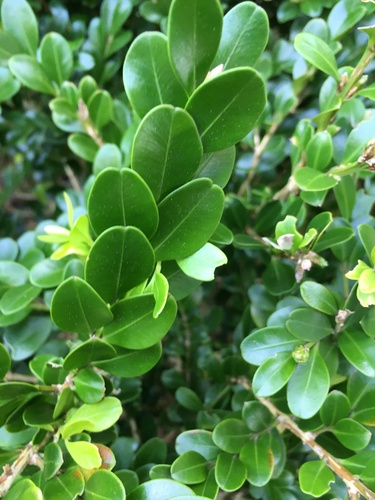
Small-leaved Box
Buxus microphylla
A masterpiece of compact greenery, the Small-leaved Box is the ultimate year-round anchor for any backyard. Its dense, waxy leaves provide a permanent sanctuary for songbirds and a fascinating stage for pollinators.
Quick Identification
Size
A dwarf evergreen shrub reaching 1 m (3.3 ft) in both height and spread; leaves are 1-2.5 cm (0.4-1 in) long.
Colors
Deep emerald green foliage; new growth is a bright lime or yellowish-green; may develop bronze tints in winter.
Key Features
- Small, rounded leathery leaves
- Opposite leaf arrangement along the stem
- Dense, compact and mounding growth habit
- Inconspicuous, petal-less yellow-green flowers in spring
- Evergreen foliage that persists through all seasons
When You’ll See Them
Loading activity data...
Behavior
The Small-leaved Box is a slow-growing, resilient evergreen known for its incredible adaptability and longevity. While it doesn't move like the animals we usually track, it exhibits a steady growth 'behavior' that makes it a cornerstone of garden design. It is highly tolerant of heavy pruning and shearing, which has made it a favorite for formal hedges and topiary for centuries.
In a backyard ecosystem, this shrub serves as a vital structural element. Its dense, tightly packed branches provide excellent nesting sites for small songbirds and essential cover for beneficial insects and spiders. Unlike many other shrubs that go dormant or lose their leaves, the Small-leaved Box maintains its thick canopy year-round, offering a permanent sanctuary for wildlife during harsh winter months.
EverydayEarth exclusive
Camera Tips
When using an AI-powered camera to monitor a Small-leaved Box, think of the shrub as a 'stage' for other wildlife. Because of its dense foliage, it is a frequent stop for birds like wrens or sparrows looking for a safe place to hide. Position your camera about 2 to 3 feet away from the shrub, angled slightly upward if you are aiming for the mid-section, or level with the ground to catch creatures emerging from the shadows at the base.
If you want to capture the hidden world of insects, use a macro lens or a close-focus setting. During the spring (typically March and April), the inconspicuous flowers emit a faint fragrance that attracts bees and flies. Set your camera to take short, high-resolution video bursts during the morning hours when these pollinators are most active. This is also a great time to see if any spiders have spun intricate webs between the small, waxy leaves.
For those interested in the 'slow' life of the plant itself, time-lapse mode is your best friend. Set your camera to take one photo every few hours over the course of a week in early spring. You will be able to see the 'flush' of bright lime-green new growth as it pushes out from the tips of the darker, older leaves. This provides a fascinating look at the plant's seasonal transition that is often too slow to see with the naked eye.
Avoid placing the camera too close to the foliage if the area is windy, as the movement of the leaves can trigger thousands of 'false positive' recordings. Instead, use a 'zone detection' feature if your camera software allows it, focusing the trigger area on the airspace just in front of the shrub or the ground directly beneath it where small mammals like chipmunks might forage in the leaf litter.
Similar Species
Species that look similar or are commonly confused with Small-leaved Box.
Frequently Asked Questions
Record Small-leaved Box at your habitat
Connect a camera to start building your own species record — AI identifies every visitor automatically.