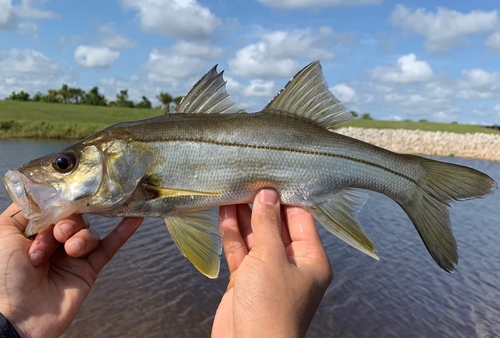
Smallscale Fat Snook
Centropomus parallelus
A deep-bodied master of disguise, the Smallscale Fat Snook lurks within the shadows of mangrove roots and dock pilings. This elusive coastal resident is a prize for any backyard observer with a camera beneath the waves.
Quick Identification
Size
Typically 25–50 cm (10–20 in) in length, reaching a maximum of about 60 cm (24 in); weight ranges from 1–3.5 kg (2.2–7.7 lbs).
Colors
Silvery-grey to dull gold body with a prominent black lateral line; fins often show a distinct yellowish or pale orange hue, particularly the anal and pelvic fins.
Key Features
- Strongly arched back and deep body profile
- Prominent black lateral line extending into the caudal fin
- Protruding lower jaw with a sharp, pointed snout
- Smaller scales compared to the Common Snook
When You’ll See Them
Geographic range
Where Does the Smallscale Fat Snook Live?
Native to the tropical and subtropical shores of the Western Atlantic Ocean, the Smallscale Fat Snook thrives from the southern tip of Florida and the Gulf of Mexico down through the Caribbean Sea. Its core populations are found along the coastlines of Central and South America, extending as far south as Florianópolis, Brazil, where it favors the sheltered waters of coastal lagoons and river mouths.
Basemap © OpenStreetMap contributors
Behavior
The Smallscale Fat Snook is a patient and calculating ambush predator, a trait that defines its daily life in the tangled roots of coastal mangroves. Unlike its larger cousins that may venture further into open coastal waters, the Fat Snook is a homebody of the estuaries, often found hovering nearly motionless in the shadows of submerged structures. They are euryhaline, meaning they are remarkably comfortable in a wide range of salinities, frequently moving from the salty ocean front into the completely fresh water of coastal rivers and springs.
These fish are generally solitary but can congregate in small, loose schools during spawning or around high-protein food sources. They are famous for their 'thump'—a sound produced by the rapid contraction of muscles against their swim bladder—which they use to communicate or when startled. While they are a challenge for anglers due to their intelligence and tendency to retreat into heavy cover, they are peaceful neighbors in suburban canal systems, provided the water quality remains high.
EverydayEarth exclusive
Camera Tips
To successfully document the Smallscale Fat Snook, you must think like an underwater cinematographer. The most effective setup involves placing a waterproof action camera or a submersible trail cam near 'structural intersections'—places where dock pilings meet the sea floor or where mangrove prop roots create a natural cage. Mount the camera low, about 12 inches from the bottom, and angle it slightly upward to capture the sunlight reflecting off the fish's silver sides. Snook are highly sensitive to vibrations, so ensure your mounting bracket is rock-solid to avoid 'ghosting' or startling the fish.
Timing your recording is the secret to getting great footage. Smallscale Fat Snook are 'tide-runners'; they move into the shallows to hunt as the tide rises and retreat to deeper holes as it falls. Set your camera's timer to trigger during the two hours surrounding a high tide. If your camera has a time-lapse or high-frequency trigger mode, use it during the 'golden hours' of dawn and dusk, when these fish are most likely to leave the safety of the roots to strike at passing baitfish.
In many suburban backyards, dock lights are a secret weapon. At night, Fat Snook will hover just outside the circle of light, waiting for prey to be silhouetted. Position your camera on the 'shadow line' of a dock light to capture spectacular nocturnal hunting behavior. Since water clarity can be an issue in estuaries, try to place the camera within three feet of the area you expect the fish to traverse, and use a wide-angle lens to maximize the field of view in murky conditions.
Lastly, maintenance is key in the brackish environments these fish call home. Salt and algae can quickly obscure a lens. If you are leaving a camera submerged for several days, apply a thin layer of specialized rain-repellent or anti-fouling solution to the lens housing to prevent barnacles or film buildup. Check the housing seals frequently, as the salinity changes in these habitats can be hard on standard rubber gaskets.
Similar Species
Species that look similar or are commonly confused with Smallscale Fat Snook.
Frequently Asked Questions
Record Smallscale Fat Snook at your habitat
Connect a camera to start building your own species record — AI identifies every visitor automatically.