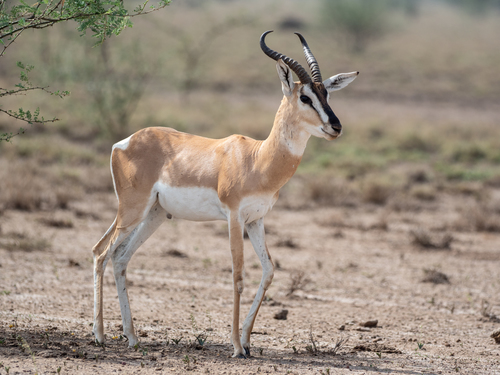
Sömmerring's Gazelle
Nanger soemmerringii
Elegant, resilient, and strikingly marked, Sömmerring's Gazelle is a true specialist of the Horn of Africa's sun-drenched plains. With its signature lyre-shaped horns and bold facial stripes, it is one of the most visually stunning bovids of the arid savanna.
Quick Identification
Size
Shoulder height: 80–90 cm (31–35 in); Weight: 35–45 kg (77–100 lbs)
Colors
Pale fawn to clay-colored upper body with a stark white belly and rump; face features two bold black stripes running from the horns through the eyes to the muzzle.
Key Features
- Lyre-shaped horns that curve backward and hook sharply inward at the tips
- Distinctive white rump patch that extends slightly onto the lower back
- Bold black facial markings contrasted against a white-and-tan face
- Absence of a dark lateral stripe on the flanks, unlike many other gazelles
When You’ll See Them
Behavior
These gazelles are mixed feeders, meaning they are equally comfortable grazing on short grasses as they are browsing on the leaves of drought-resistant acacia shrubs. When startled, they exhibit a behavior known as 'stotting'—jumping high into the air with stiff legs—which serves as a signal to predators that they are fit and difficult to catch. While naturally wary, they can be seen in larger congregations during the dry season when they gather near the few remaining water sources.
EverydayEarth exclusive
Camera Tips
To successfully capture Sömmerring's Gazelle on a trail camera, placement is everything. These animals have a high line of sight, so mount your camera approximately 3 to 4 feet off the ground. If you place it too low, you may only capture their legs, and if it's too high, you’ll lose the detail of their unique inward-curving horns. Angle the camera toward an open clearing or a well-trodden game trail leading toward a water source. Because they inhabit open plains, ensure your camera has a wide-angle lens or is positioned at least 15 feet back from the trail to capture the entire herd as they move through.
Lighting in the African savanna can be punishing. To avoid blown-out images where the white rump patch appears as a glowing orb, orient your camera to the North or South. This prevents the harsh morning or evening sun from shining directly into the lens. Use a camera with a rapid trigger speed—ideally under 0.4 seconds—as these gazelles are constant movers and rarely stand still for long. If your device supports 'Burst Mode,' set it to take 3-5 photos per trigger to increase your chances of getting a clear shot of their distinct facial stripes.
While Sömmerring's Gazelle won't be attracted to store-bought baits, you can leverage their natural habits. In arid regions, a permanent or solar-powered water trough is the ultimate 'lure.' If you are on a large property or conservancy, look for 'dusting bowls'—depressions in the earth where gazelles groom themselves. Setting your camera to record 15-second video clips at these locations can provide fascinating footage of their social interactions and grooming behaviors. During the heat of the day, they often seek the thin shade of acacia trees, making these shaded spots excellent secondary locations for midday monitoring.
Similar Species
Species that look similar or are commonly confused with Sömmerring's Gazelle.
Grant's Gazelle
Larger in size with horns that diverge outward rather than hooking inward at the tips.
Thomson's Gazelle
Easily distinguished by the bold black stripe running horizontally along its flank, which Sömmerring's lacks.
Speke's Gazelle
Much smaller with a unique protuberance on its nose and a more restricted range in the Horn of Africa.
Frequently Asked Questions
Record Sömmerring's Gazelle at your habitat
Connect a camera to start building your own species record — AI identifies every visitor automatically.