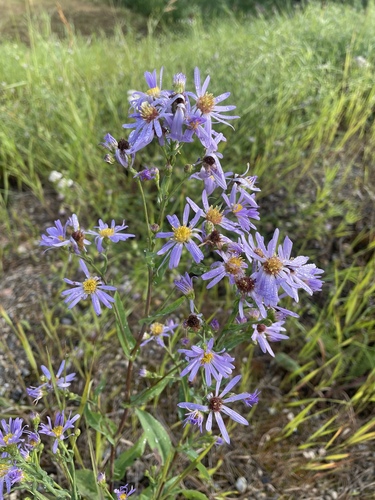
smooth blue aster
Symphyotrichum laeve
A late-season masterpiece of the prairie, the smooth blue aster paints the autumn landscape in shades of sapphire and violet. Its waxy, sky-colored stems and nectar-rich blooms make it an essential stop for migrating butterflies and a highlight for any backyard camera.
Quick Identification
Size
2-4 feet (60-120 cm) in height with a spread of 1.5-2 feet (45-60 cm)
Colors
Sky-blue to violet-blue ray petals; central disks start yellow and mature to a deep reddish-purple; foliage is a distinctive glaucous bluish-green.
Key Features
- Smooth, hairless stems with a waxy, bluish-green coating
- Leaves that 'clasp' or wrap partially around the stem at the base
- Vibrant blue to lavender daisy-like flowers with yellow centers
- Lance-shaped, thick, and leathery leaves that feel greasy or smooth to the touch
When You’ll See Them
Behavior
The smooth blue aster is one of the most elegant late-season performers in the natural world. While many wildflowers begin to wither as autumn approaches, this species bursts into a cloud of blue and violet, providing a vital nectar source for insects preparing for winter. It is known for its sturdy, upright habit; unlike many other tall asters, its smooth, waxy stems are remarkably strong and rarely flop over, even after a heavy autumn rain.
In a backyard setting, this plant acts as a social hub for local wildlife. It is particularly famous for its relationship with the Monarch butterfly, serving as a critical refueling station during their long southern migration. The flowers are also highly attractive to native bees and syrphid flies. Because it spreads through both wind-dispersed seeds and slow-growing underground rhizomes, it creates stable, long-lived colonies that offer consistent habitat year after year.
EverydayEarth exclusive
Camera Tips
To capture the stunning colors of the smooth blue aster, position your AI camera at a 'pollinator's eye view'—roughly 2 to 3 feet off the ground. Because the blue-to-violet petals can sometimes appear washed out in harsh midday sun, try to angle your camera so the flowers are backlit or partially shaded by taller grasses. This highlighting will make the waxy, glaucous stems and the vibrant yellow flower centers pop against the background. Using a camera with a high-resolution sensor is key here, as the fine details of the central disk florets are what make these shots truly professional.
Since the smooth blue aster is a magnet for insects, set your camera to a high-trigger sensitivity or use a 'Short Video' mode. You aren't just filming a plant; you are filming a busy intersection of wildlife. Look for the distinctive metallic green of sweat bees or the orange-and-black patterns of Monarchs. If your camera allows for manual focus, set the focal point on a cluster of buds that are just beginning to open. This will ensure that when a butterfly lands to feed, it is perfectly crisp in the frame.
Don't stop recording once the sun goes down. While the flowers are diurnal, the structure of the plant provides excellent cover for small tree frogs or predatory mantids at night. If you're using a trail camera with an infrared flash, you can capture these nocturnal hunters waiting in ambush among the leaves. For the best seasonal results, leave your camera in place from late August through the first frost to document the fascinating transition of the flower centers from yellow to deep purple, a visual signal the plant uses to tell bees that the nectar is gone.
Similar Species
Species that look similar or are commonly confused with smooth blue aster.
Frequently Asked Questions
Record smooth blue aster at your habitat
Connect a camera to start building your own species record — AI identifies every visitor automatically.