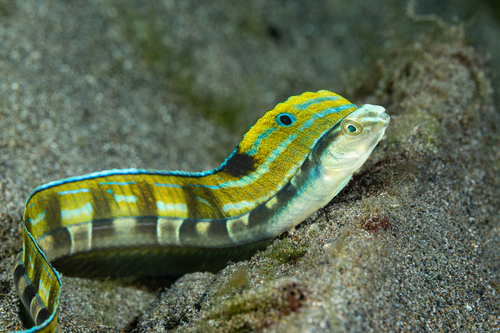
Snake Blenny
Xiphasia setifer
Meet the ocean's ribbon-dancer. The Snake Blenny is an extraordinary, eel-like fish that spends its days peeking from the sand and its nights gliding through the Indo-Pacific currents.
Quick Identification
Size
Reaches up to 53 cm (21 inches) in length; it is the longest species of combtooth blenny, characterized by an extremely slender, ribbon-like body.
Colors
Base color is typically yellowish-tan or light brown with 20 to 30 dark vertical bars along the flanks; features a distinct black spot on the anterior portion of the dorsal fin.
Key Features
- Extremely elongated, eel-like body shape
- Dorsal fin originates forward on the head, near the eyes
- Prominent, curved canine teeth in the lower jaw
- Tapered tail ending in a fine point
When You’ll See Them
Geographic range
Where Does the Snake Blenny Live?
The Snake Blenny is widely distributed across the tropical and subtropical waters of the Indo-Pacific. Its range begins in the Red Sea and extends along the East African coast, stretching across the Indian Ocean to the Western Pacific, reaching as far north as Japan and as far south as northern Australia and New Caledonia. This species thrives in the nutrient-rich coastal zones of Southeast Asia and the various island nations within the Coral Triangle.
Basemap © OpenStreetMap contributors
Behavior
The Snake Blenny is a master of the benthos, known for its unique burrowing lifestyle. Unlike many of its relatives that inhabit rocky crevices, this species prefers soft substrates where it can construct its own burrows or occupy abandoned ones. During the day, it is often seen with only its head poking out of the sand, scanning for predators or drifting food, retreating instantly if it feels threatened.
At night, the Snake Blenny becomes more active, sometimes emerging fully to swim with a graceful, undulating motion similar to a water snake or an eel. It is a largely solitary creature but can be found in relatively high concentrations where the sediment is ideal for burrowing. In the aquarium world, it is prized for its unusual appearance, though it requires specialized care and a deep sand bed to mimic its natural environment.
EverydayEarth exclusive
Camera Tips
To capture high-quality footage of a Snake Blenny, you will need a dedicated underwater trail camera or a waterproof action camera with an external power source. Because these fish are burrowers, placement is everything. Position your camera on a weighted low-profile tripod about 10-15 inches away from a suspected burrow entrance—look for clean, circular holes in sandy or silty patches near the reef edge. Angle the lens slightly downward to ensure the AI can capture the fish's head and the distinctive spots on its dorsal fin as it emerges.
Since Snake Blennies are primarily nocturnal, your camera must have excellent infrared (IR) capabilities. Avoid using standard white-light strobes, as the sudden flash will likely scare the fish back into its hole for the remainder of the night. Using a dim red light as a focus assist can help your camera lock focus without disturbing the blenny's natural behavior. Ensure the camera is set to record at a high frame rate (at least 60fps) to catch the fluid, snake-like movement of their body as they exit the burrow.
Baiting can significantly increase your chances of a close-up encounter. Secure a small mesh bag containing crushed mollusks or oily fish scraps near the burrow entrance. This scent trail will often entice the blenny to fully emerge from its hole to investigate. Be mindful of the tide; if you are in a shallow coastal area, ensure your camera is deep enough to remain submerged during low tide to avoid water surface reflections or overheating. Check your camera housing seals frequently, as the silty environments favored by this species can be abrasive to O-rings.
Similar Species
Species that look similar or are commonly confused with Snake Blenny.
Frequently Asked Questions
Record Snake Blenny at your habitat
Connect a camera to start building your own species record — AI identifies every visitor automatically.