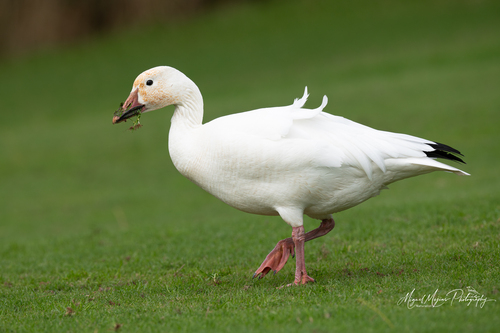
Snow Goose
Anser caerulescens
Witness the breathtaking 'white ghost' of the winter skies. Snow Geese are masters of migration, filling the air with their iconic calls and transforming landscapes into shimmering fields of white.
Quick Identification
Size
Length: 25–31 in (64–79 cm); Wingspan: 51–65 in (130–165 cm); Weight: 4.5–10 lbs (2–4.5 kg)
Colors
White morph is entirely white with black wingtips; Blue morph has a dark grayish-brown body with a white head. Both have pink bills and legs.
Key Features
- White plumage with black primary wingtips
- Pink bill with a distinct black 'grinning patch' on the side
- Stocky body with a shorter neck than a swan
- Often seen in massive, noisy flocks numbering in the thousands
When You’ll See Them
Behavior
Snow Geese are incredibly social birds known for their massive migratory flocks that can turn an entire field white. They are highly vocal, creating a constant cacophony of high-pitched honks and barks that can be heard from miles away. During the winter, they spend their days grazing in agricultural fields and their nights roosting on open water, often moving in spectacular 'snowstorms' of wings when startled.
These geese exhibit a unique foraging behavior called 'grubbing,' where they use their strong, serrated bills to pull up the entire root systems of aquatic plants and grasses. While they are generally wary of humans and will take flight if approached, they have become increasingly common in suburban areas near large parks or corporate campuses with expansive lawns and nearby retention ponds.
EverydayEarth exclusive
Camera Tips
To capture Snow Geese on a trail camera, placement is everything. These birds are ground-feeders that prefer wide-open spaces where they can spot predators from a distance. Instead of mounting your camera on a tree, use a ground stake or a low tripod positioned at the edge of a harvested cornfield or a shallow wetland. Aim the lens horizontally about 12 to 18 inches off the ground to capture their natural eye-level perspective and the intricate details of their 'grinning patch' on the bill.
Because Snow Geese travel in dense, fast-moving groups, motion blur can be a significant issue. Set your camera to its fastest possible shutter speed and use a 'burst' or 'multi-shot' mode. This increases your chances of capturing a clear image of an individual bird amidst the chaos of a landing or taking-off flock. If your camera supports high-definition video, 60fps is ideal for slowing down the dramatic motion of their wingbeats during descent.
Timing is crucial for the best lighting. Snow Geese are most active during the 'golden hours' of dawn and dusk. Their white plumage is highly reflective and can easily 'blow out' or lose detail in bright midday sun. If you are setting up in a backyard that borders a field, you can attract them into your camera's frame by keeping a short, lush lawn, though they are much more likely to visit if they see other waterfowl already present. In larger areas, using a few white goose decoys can act as a visual lure to bring a passing flock within range of your sensor.
Finally, pay attention to the wind. Like airplanes, geese prefer to take off and land into the wind. By positioning your camera with the wind at its back, you are more likely to capture the birds flying directly toward the lens as they come in for a landing. Ensure your camera uses 'No-Glow' or 'Black' infrared LEDs for nighttime or twilight shots, as these birds are surprisingly skittish and can be easily spooked by a visible red glow.
Similar Species
Species that look similar or are commonly confused with Snow Goose.
Ross's Goose
Much smaller with a shorter, triangular bill that lacks the black 'grinning patch' seen on the Snow Goose.
Tundra Swan
Significantly larger with a much longer neck and an all-black bill that lacks the Snow Goose's serrated edges.
Canada Goose
Identifiable by its black head and neck with a white 'chinstrap,' whereas the Snow Goose is primarily white or gray-brown.
Frequently Asked Questions
Record Snow Goose at your habitat
Connect a camera to start building your own species record — AI identifies every visitor automatically.