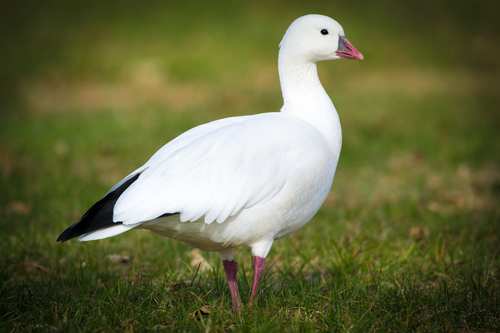
Ross's Goose
Anser rossii
The Ross's Goose is a petite, elegant traveler of the North American flyways. Often mistaken for its larger cousin, the Snow Goose, this 'pint-sized' goose brings a touch of arctic beauty to winter wetlands and suburban ponds alike.
Quick Identification
Size
Length: 53-66 cm (21-26 in); Wingspan: 113-115 cm (44-45 in); Weight: 1.2-1.6 kg (2.6-3.5 lbs)
Colors
Adults are snowy white overall with jet-black wingtips. The bill is pink with a pale blue-gray base, and legs are pink. Both sexes look identical.
Key Features
- Diminutive size, roughly equal to a Mallard duck
- Stubby pink bill lacking the black 'grin patch' found on Snow Geese
- Short, thick neck and a rounded head shape
- Distinctly black primary wing feathers visible during flight
When You’ll See Them
Behavior
Ross's Geese are incredibly social birds, almost always found in the company of other waterfowl. They are famous for their long-distance migrations, traveling in massive, noisy flocks that can number in the thousands. While they were once considered rare, their populations have surged, and they are now frequently seen mixed in with larger Snow Goose colonies. They are generally more docile and less aggressive than their larger cousins, often feeding on the periphery of the main flock.
In a backyard or park setting, these geese spend most of their daylight hours grazing. They are surface feeders that prefer to walk through short-grass fields or shallow wetlands, clipping vegetation with their small, sharp bills. Because they are highly vigilant, they rely on the collective 'eyes' of the flock to spot predators, making them difficult to approach closely without spooking the entire group.
EverydayEarth exclusive
Camera Tips
To capture the Ross's Goose on a trail camera, focus on the 'landing zones' near the water’s edge or in open patches of short-cropped grass. Because these birds are smaller than most geese, place your camera at a low height—roughly 12 to 18 inches off the ground—and angle it slightly upward. This 'goose-eye view' creates a much more intimate and professional-looking portrait than a downward-facing angle from a fence post. Position the camera with the sun at its back to avoid silhouetting these bright white birds against the sky or water.
White-feathered birds are notorious for 'blowing out' or overexposing in digital images. If your AI-powered camera has adjustable exposure settings, consider underexposing by -0.5 or -1.0 EV during the middle of the day. This ensures that the fine texture of the feathers is preserved rather than appearing as a solid white blob. For those using traditional trail cams, placing the camera in an area with consistent, filtered light (like a field edge near some brush) can help manage the high contrast of their plumage.
Since Ross's Geese move in groups, set your camera to 'Burst Mode' or 'Photo Series' with at least 3-5 shots per trigger. This increases your chances of capturing behavioral quirks, such as the 'head-flip' greeting or social preening. If you are on private land where it is legal, scattering a small amount of cracked corn or birdseed in a 10-foot radius in front of the camera can encourage a flock to linger long enough for the AI to trigger and identify the species.
During the winter months, look for 'leads' or open water in icy ponds. Geese will congregate heavily in these small patches of water to drink and bathe. Setting your camera near these openings is a surefire way to get high-action shots of splashing and wing-stretching. Be sure your trigger speed is set to its fastest possible setting (0.2s to 0.5s) to catch them as they glide into the frame, as their landing approach is remarkably fast for such a small bird.
Similar Species
Species that look similar or are commonly confused with Ross's Goose.
Snow Goose
Much larger with a longer neck and a large bill featuring a prominent black 'grin patch' along the mandibles.
Cackling Goose
Similar in size but has a dark brown/black body with a white cheek patch, resembling a miniature Canada Goose.
Tundra Swan
Significantly larger with a much longer neck and an all-black bill that lacks the pink tones of the Ross's Goose.
Frequently Asked Questions
Record Ross's Goose at your habitat
Connect a camera to start building your own species record — AI identifies every visitor automatically.