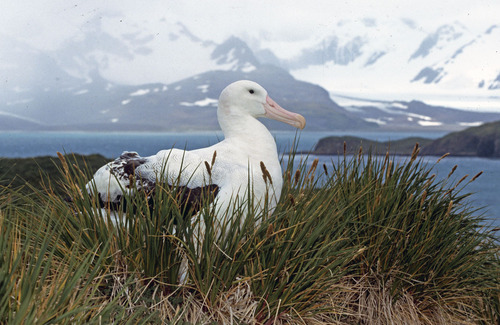
Snowy Albatross
Diomedea exulans
Meet the undisputed king of the skies, possessing the largest wingspan of any living bird. The Snowy Albatross is a master of the Southern Ocean, capable of circling the globe while barely flapping its wings.
Quick Identification
Size
Length: 107-135 cm (3.5-4.4 ft); Wingspan: 2.5-3.5 m (8.2-11.5 ft); Weight: 6-12.7 kg (13-28 lbs)
Colors
Adults are snowy white with black wingtips; juveniles are chocolate brown, gradually whitening with age. Males typically appear whiter than females.
Key Features
- World's largest wingspan, reaching up to 11.5 feet
- Massive, pinkish-hooked bill with prominent nasal tubes
- Snow-white body plumage in mature adults
- Long, narrow wings designed for effortless gliding
When You’ll See Them
Behavior
The Snowy Albatross is a legendary traveler, spending the majority of its fifty-plus-year lifespan in the air above the Southern Ocean. They utilize a specialized flight technique called dynamic soaring, which allows them to harness the wind's energy to travel thousands of miles with barely a flap of their wings. While largely solitary at sea, they are deeply social during the breeding season, returning to the same remote islands to engage in elaborate, multi-year courtship rituals.
On the water, they are opportunistic foragers, often following ships for discarded scraps. Their social structure is defined by long-term monogamy; once a pair bond is formed through years of dancing and bill-clapping, it usually lasts for life. Despite their grace in the air, they can be somewhat clumsy on land, requiring long 'runways' to take flight against the wind.
EverydayEarth exclusive
Camera Tips
Capturing the Snowy Albatross is a high-seas adventure. Because these birds rarely come near land except to breed on restricted islands, your best chance for a 'backyard' shot is if your backyard is the deck of a coastal vessel or a shoreline overlooking the Southern Ocean. If you are setting up a trail camera on a permitted nesting site, position the camera at ground level (1-2 feet) using a weighted tripod to withstand high Antarctic winds. Aim the lens toward the windward side of a ridge, as these birds always land and take off facing into the wind.
Use a camera with an extremely fast trigger speed or a 'pre-roll' video feature. Because the Snowy Albatross glides at speeds up to 80 mph, a slow trigger will result in nothing but a frame of empty sky or a blurry wingtip. Set your AI detection to 'Bird' but increase the sensitivity to the highest level. For nesting shots, focus on the 'social areas' where younger birds practice their dances; the movement is slower here, allowing for better focus and high-definition video of their bill-clapping behavior.
Lighting is your biggest challenge. The white plumage of the Snowy Albatross can easily 'blow out' in bright sun against dark ocean water. Use a camera with strong High Dynamic Range (HDR) settings to preserve detail in the feathers. If you are on a boat, use a gimbal mount for your camera to counteract the swell of the sea, ensuring the horizon stays level. Since they are active during the day, infrared isn't a priority, but a polarizing filter is essential to cut through the ocean's glare and reveal the bird's true colors.
Similar Species
Species that look similar or are commonly confused with Snowy Albatross.
Southern Royal Albatross
Almost identical in size, but has a black line along the cutting edge of the upper bill and slightly different wing color transitions.
Tristan Albatross
Slightly smaller and darker; it takes much longer to reach the white adult plumage and is restricted to the Atlantic.
Antipodean Albatross
Generally smaller and the females remain much browner throughout their lives compared to the Snowy Albatross.
Frequently Asked Questions
Record Snowy Albatross at your habitat
Connect a camera to start building your own species record — AI identifies every visitor automatically.