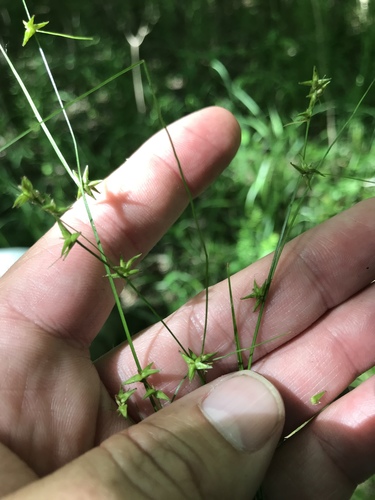
social sedge
Carex socialis
A delicate, mat-forming native sedge that transforms shaded woodland floors into lush green carpets. Social sedge is the perfect low-maintenance groundcover for moist, 'difficult' corners of the backyard.
Quick Identification
Size
Height of 20-50 cm (8-20 inches); leaf width of only 1-2 mm (0.04-0.08 inches)
Colors
Bright emerald green foliage; straw-colored to light brown flower spikes in late spring
Key Features
- Rhizomatous growth forming dense, carpet-like mats
- Extremely narrow, grass-like leaves
- Weak, reclining stems (culms) that arch toward the ground
- Small, egg-shaped flower clusters (spikes) near the stem tips
When You’ll See Them
Geographic range
Where Does the social sedge Live?
Native to the North American continent, social sedge is primarily concentrated in the interior lowlands of the United States. Its core range follows the major river systems of the Mississippi and Ohio Valleys, stretching from the moist woodlands of southern Illinois and Indiana down through the Gulf Coast states, including Louisiana, Mississippi, and eastern Texas. It thrives in the humid, temperate conditions found in the shaded bottomlands of the American Southeast and Midwest.
Basemap © OpenStreetMap contributors
Behavior
Unlike many sedges that grow in isolated, fountain-like clumps, the social sedge is true to its name. It spreads horizontally via underground rhizomes, creating a continuous, lush green tapestry across the forest floor. This "social" behavior allows it to dominate small patches of the understory, providing a soft texture that contrasts with the woody debris of its native woodland habitats.
As the season progresses from spring into summer, the plant's slender stems become top-heavy with seed heads. These stems eventually lose their upright posture and recline gracefully against the ground or neighboring plants. This growth habit makes it an excellent choice for soil stabilization in shaded areas, as its root systems weave together to form a resilient underground network.
EverydayEarth exclusive
Camera Tips
Capturing the beauty of social sedge requires a focus on texture and macro details. To highlight its unique 'social' carpet-like growth, set your camera at a low angle, roughly 5-10 inches off the ground, using a wide-angle lens. This perspective allows you to show how the sedge fills the frame as a groundcover, rather than just appearing as individual blades of grass.
Because social sedge lives in shaded bottomlands, lighting can be a challenge. The best shots are often captured during the 'golden hour' when low-angled light filters through the tree canopy, creating a dappled effect on the emerald leaves. If your camera allows for manual focus, aim for the small, egg-shaped flower spikes (perigynia) that appear in late spring (May-June). These are the plant's most identifying features.
For trail camera users, social sedge patches are excellent locations to monitor wildlife. Small mammals like voles and shrews, as well as ground-nesting birds, frequently use these dense mats for cover. Position your camera to face a transition zone where the sedge mat meets a log or water source. You don't need bait for the plant itself, but the natural cover it provides makes it a high-traffic area for backyard critters seeking a safe path through the woods.
Similar Species
Species that look similar or are commonly confused with social sedge.
Frequently Asked Questions
Record social sedge at your habitat
Connect a camera to start building your own species record — AI identifies every visitor automatically.