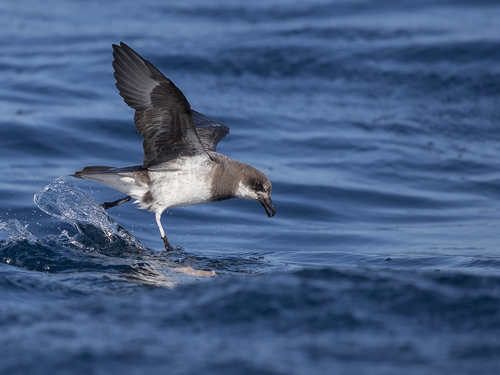
Soft-plumaged Petrel
Pterodroma mollis
A master of the southern gales, the Soft-plumaged Petrel is a ghost of the open ocean. Known for its acrobatic flight and secret nocturnal life, this 'gadfly' petrel is a rare and rewarding sight for any coastal observer.
Quick Identification
Size
Length: 32-37 cm (12.5-14.5 in); Wingspan: 83-95 cm (33-37 in); Weight: 230-340 g (8-12 oz)
Colors
Slate-grey upperparts with a dark 'M' marking; white underparts featuring a distinctive grey breast band; dark eye patch against a pale face.
Key Features
- Dark grey breast band (sometimes incomplete)
- Distinctive dark patch around the eye
- High, arcing 'gadfly' flight style
- White underwings with dark leading edges
When You’ll See Them
Behavior
The Soft-plumaged Petrel is a quintessential 'gadfly' petrel, a name derived from its fast, erratic, and high-arcing flight pattern. Unlike many larger albatrosses that glide majestically, this species wheels and dives through the air with incredible agility, often using the wind reflecting off wave fronts to propel itself. While they are silent and solitary at sea, they become highly social and vocal when returning to their breeding colonies on remote subantarctic islands.
To protect themselves from predatory birds like skuas, Soft-plumaged Petrels are strictly nocturnal when visiting land. They arrive at their nesting sites under the cover of darkness, filling the air with a chorus of moans and whistles as they navigate to their underground burrows. These birds are long-lived and typically mate for life, returning to the same burrow year after year to raise a single chick.
EverydayEarth exclusive
Camera Tips
Capturing the Soft-plumaged Petrel on camera is a unique challenge because they are almost exclusively pelagic. Unless you are stationed on a remote island like Gough, Marion, or the Antipodes, you won't find these in a traditional suburban backyard. For researchers or residents of these remote outposts, camera traps should be positioned approximately 1 to 2 feet off the ground, angled directly at the entrance of known active burrows. Because these birds are nocturnal on land, use a camera with 'No-Glow' or 'Black' infrared LEDs; standard 'Low-Glow' IR can sometimes startle them, leading to abandoned entries.
Set your camera to a high-sensitivity trigger and use 'Burst Mode' to capture 3-5 photos per trigger. These petrels are remarkably fast when landing and scuttling into their holes to avoid predation, so a fast trigger speed (0.2 seconds or less) is essential. Since they breed on steep, windy slopes, ensure your camera housing is weighted or securely strapped to a T-post or a sturdy rock to prevent 'false triggers' caused by wind-blown tussock grass. If possible, clear a small 3-foot radius of tall grass directly in front of the lens to keep the focus sharp on the bird rather than the vegetation.
Video mode is particularly effective for this species to record their unique vocalizations and social interactions. If you are using video, set the duration to 15-20 seconds with a minimal 're-arm' time. Be mindful of the salt-heavy air and extreme humidity of their island habitats; using desiccant silica gel packets inside the camera housing is a must to prevent lens fogging during the damp nocturnal hours when the birds are most active.
Similar Species
Species that look similar or are commonly confused with Soft-plumaged Petrel.
White-headed Petrel
Much paler head and lacks the dark grey breast band of the Soft-plumaged Petrel.
Mottled Petrel
Features a distinct dark grey patch on the belly rather than a band across the breast.
Great-winged Petrel
Almost entirely dark brown/black plumage, lacking the white underparts and breast band.
Frequently Asked Questions
Record Soft-plumaged Petrel at your habitat
Connect a camera to start building your own species record — AI identifies every visitor automatically.