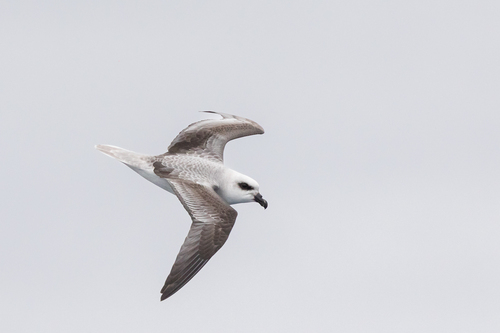
White-headed Petrel
Pterodroma lessonii
The White-headed Petrel is a spectral wanderer of the Southern Ocean, easily identified by its ghostly white plumage and piercing dark eyes. A marvel of aeronautic efficiency, it spends its life navigating the world's most turbulent seas.
Quick Identification
Size
Length of approximately 40 cm (16 in); wingspan between 105–110 cm (41–43 in); weight typically 600–800 g (1.3–1.8 lbs).
Colors
Bright white head and neck with a distinctive dark patch around the eyes; pale grey mantle and back; dark grey-brown upper wings; pure white underparts.
Key Features
- White head with prominent dark 'eye smudge'
- Long, pointed wings with dark upper surfaces
- Robust black bill with a hooked tip
- Pale grey tail often visible in flight
When You’ll See Them
Behavior
The White-headed Petrel is a master of the open ocean, spending the vast majority of its life soaring over the rolling waves of the Southern Hemisphere. These birds are renowned for their high-speed 'shearing' flight, where they use the wind gradients above the water to arc effortlessly through the air with minimal wing flapping. While they are solitary wanderers at sea, they transform into social creatures during the breeding season, congregating in massive colonies on subantarctic islands.
On land, these petrels are far less graceful than in the air. Because their legs are positioned far back on their bodies for efficient swimming and diving, they move with a clumsy, shuffling gait. To avoid predation by skuas and gulls, they are strictly nocturnal when visiting their nesting burrows, filling the night air with a cacophony of whistling and moaning calls that can be quite eerie to the uninitiated.
EverydayEarth exclusive
Camera Tips
Capturing a White-headed Petrel on camera is a unique challenge because they are almost never seen on the mainland. If you live on a subantarctic island or near a known breeding colony, your best bet is to position your camera near the entrance of their nesting burrows. Look for holes in the ground beneath heavy tussock grass or alpine vegetation. Set your camera low to the ground, approximately 6–12 inches high, and angle it slightly upward to capture the bird as it lands or emerges from the tunnel.
Because these birds are strictly nocturnal on land, you must use a camera with high-quality infrared (no-glow) flash. Standard white flashes will disorient the birds and may attract predators. Given their fast movements and the dark conditions, set your camera to a high trigger speed and consider using 'Burst Mode' to capture 3–5 photos per trigger. This increases your chances of getting a clear shot of the bird's distinctive white head and facial markings before it disappears into the burrow.
While traditional 'bait' doesn't work for these birds in a backyard setting, the sound of their own species can be a powerful lure. If you are a researcher or have the proper permits, playing recorded petrel calls near the camera can sometimes pique their curiosity. However, for most enthusiasts, seasonal timing is the most important factor—focus your efforts between November and February when chick-rearing activity is at its peak and adults are frequently returning to the nest with food.
In coastal areas where 'beach-wrecked' birds might occur after heavy storms, a camera set up at bird eye level on a sandy beach can occasionally capture these birds resting. Always maintain a respectful distance and avoid using bright flashlights, as these pelagic specialists are highly sensitive to light pollution which can cause them to crash-land or become grounded.
Similar Species
Species that look similar or are commonly confused with White-headed Petrel.
Great-winged Petrel
Much darker overall, with a soot-grey or blackish head compared to the White-headed Petrel's bright white face.
Soft-plumaged Petrel
Smaller with a darker grey crown and a prominent dark breast-band that the White-headed Petrel lacks.
Grey Petrel
Lacks the white head and has more uniform grey plumage across the upper body and head.
Frequently Asked Questions
Record White-headed Petrel at your habitat
Connect a camera to start building your own species record — AI identifies every visitor automatically.