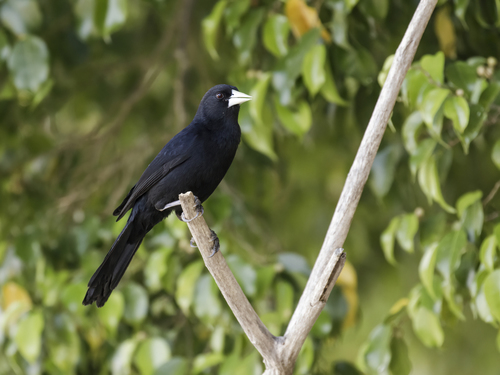
Solitary Black Cacique
Cacicus solitarius
The Solitary Black Cacique is the sophisticated loner of the marshland. With its sleek black feathers and ivory bill, it brings a sense of mystery and a world-class talent for mimicry to any backyard it visits.
Quick Identification
Size
Length of 26–29 cm (10–11.5 inches); weight ranges from 70–100 grams (2.5–3.5 ounces).
Colors
Uniformly velvety black plumage; striking ivory-white or cream-colored conical bill; dark eyes that may appear blue-gray in certain light.
Key Features
- Entirely black plumage with no colored patches
- Heavy, pointed ivory-white bill
- Usually observed alone or in pairs rather than colonies
- Long, slightly rounded tail
- Complex, melodic song with frequent mimicry
When You’ll See Them
Behavior
True to its name, the Solitary Black Cacique lacks the gregarious, colonial nesting habits of its relatives. While other caciques are known for their massive, hanging nest colonies and constant chatter, this species prefers a more quiet and independent lifestyle. It is a bird of the shadows and thickets, typically found moving through dense vegetation near water sources. Its movements are deliberate as it hops through the mid-canopy, often using its powerful bill to probe into dead leaves or bromeliads.
Despite its solitary nature, it is a magnificent vocalist. It is a master of mimicry, often incorporating the calls of other birds into its own complex repertoire of whistles, clicks, and bell-like tones. While they generally avoid human contact, they are not particularly timid and will frequent backyard gardens that offer enough cover and food. They are most often seen singly or in pairs, never forming the large, roving flocks seen in other blackbird species.
EverydayEarth exclusive
Camera Tips
To capture high-quality footage of a Solitary Black Cacique, you must focus on 'edge' habitats. These birds are rarely found in the middle of an open lawn; instead, they hug the boundaries where dense shrubs meet more open garden spaces. Place your camera at a height of 4 to 6 feet, angled slightly downward to cover both lower branches and the ground. If you have a water feature, such as a birdbath or a small pond with overhanging vegetation, this is the premier spot for camera placement, as they visit water frequently for both drinking and bathing.
Attracting this species requires a mix of food types. Use a platform feeder or a suet cage. Fruit is a major draw—offer halved oranges, bananas, or papaya. Because they are also highly insectivorous, a tray of live or dried mealworms can be a significant lure, especially during the spring and summer months. Since they are solitary, you won't get a 'crowd' at the feeder, which actually makes for cleaner, more focused shots of a single bird without the chaos of a flock.
Lighting is the biggest challenge when photographing an all-black bird. Direct midday sun will wash out the details of the feathers and create too much contrast with the pale bill. Set your camera to record during the 'golden hours' of early morning or late afternoon when the light is soft. If your AI camera allows for exposure compensation, try underexposing by -0.3 or -0.7. This prevents the bright ivory bill from becoming a white blur and allows the camera to capture the subtle textures and sheen of the black feathers.
Don't ignore the audio! If your camera has sound-triggered recording, enable it. The Solitary Black Cacique's loud, mimicry-filled song is often the first sign that they are in the area. By listening to the recordings, you can determine which specific trees or bushes they are using as 'singing posts' and move your camera accordingly for a closer shot the next day. In rainy seasons, look for areas where water collects in large-leafed plants, as these birds will often probe those spots for hidden larvae.
Similar Species
Species that look similar or are commonly confused with Solitary Black Cacique.
Frequently Asked Questions
Record Solitary Black Cacique at your habitat
Connect a camera to start building your own species record — AI identifies every visitor automatically.