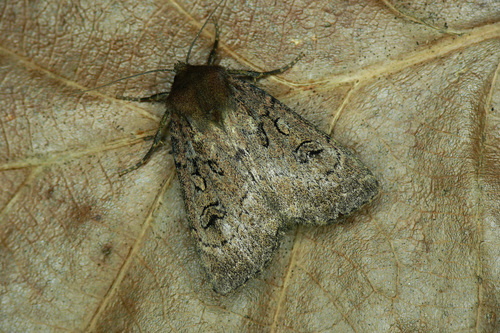
Soothsayer Dart
Graphiphora augur
A master of the midnight garden, the Soothsayer Dart is recognized by its mysterious 'dart' markings and earthy camouflage. This resilient moth is a frequent visitor to backyard sugar stations across the Northern Hemisphere.
Quick Identification
Size
Wingspan of 35–42 mm (1.4–1.7 inches); body length approximately 18–22 mm.
Colors
Forewings are typically a drab grayish-brown to reddish-brown; hindwings are a uniform pale smoky gray. Distinctive black-outlined spots on the forewings.
Key Features
- Prominent kidney-shaped (reniform) and circular (orbicular) spots outlined in black
- A small, dark horizontal dash or 'dart' at the base of the forewing
- Subtle wavy transverse lines across the wing
- Dull, silken texture to the wing scales
When You’ll See Them
Geographic range
Where Does the Soothsayer Dart Live?
The Soothsayer Dart is a wide-ranging inhabitant of the Holarctic region, naturally occurring across both North America and Eurasia. In the Western Hemisphere, it is a frequent sight from the Atlantic to the Pacific throughout Canada and the northern tier of the United States, extending its reach southward along the Western cordillera into New Mexico and California. Across the ocean, its territory stretches from the British Isles and Scandinavia all the way through the Siberian wilderness to the islands of Japan.
Basemap © OpenStreetMap contributors
Behavior
The Soothsayer Dart is a strictly nocturnal moth that spends its daylight hours tucked away in dense foliage or crevices, relying on its earthy coloration to blend in with bark and dried leaves. Once dusk falls, they become active flyers, seeking out nectar-rich flowers or fermenting fruit and tree sap. Unlike some more frantic moth species, the Soothsayer Dart often appears quite docile when feeding or resting near a light source.
As a member of the Noctuidae family, it follows a standard life cycle of one generation per year in most of its range. The larvae, often called 'cutworms,' emerge in late summer and overwinter as partially grown caterpillars. They are generalist feeders, meaning they aren't picky eaters, which allows the species to thrive in various environments without being tied to a single host plant.
EverydayEarth exclusive
Camera Tips
To capture high-quality images of the Soothsayer Dart, you should utilize a technique known as 'sugar baiting.' Mix a thick slurry of overripe bananas, brown sugar, and a bit of molasses or dark beer. Paint this mixture in a square patch on a tree trunk at eye level. Mount your AI camera on a tripod or a nearby branch, focusing specifically on the center of the bait patch. The moths will be drawn to the scent and stay relatively still while feeding, allowing for crisp, detailed shots of their wing patterns.
If you prefer using light traps, hang a white bedsheet vertically and shine a UV or mercury vapor light onto it. Position your camera about 15-20 inches away from the sheet on a tripod. The Soothsayer Dart is particularly attracted to ultraviolet spectrums and will often land on the sheet and remain motionless for several minutes. Set your camera to a macro or close-focus mode to capture the fine details of the 'dart' markings and the orbicular spots.
Because these moths are active in total darkness, your camera's infrared (IR) flash is essential. However, to avoid 'hot spots' or overexposure on the moth's reflective scales, try to diffuse the light or angle the camera slightly to the side rather than head-on. Mid-summer nights with high humidity and no moon are the peak times for activity; if it is a warm, overcast night, you are almost guaranteed to see them at your station.
Similar Species
Species that look similar or are commonly confused with Soothsayer Dart.
Double Square-spot
Features a prominent dark square or rectangular bridge between the two main wing spots, whereas the Soothsayer Dart has simpler black outlines.
Lesser Yellow Underwing
While similar in forewing color, this species reveals bright yellow or orange hindwings when it flies, unlike the pale gray hindwings of the Soothsayer Dart.
Frequently Asked Questions
Record Soothsayer Dart at your habitat
Connect a camera to start building your own species record — AI identifies every visitor automatically.