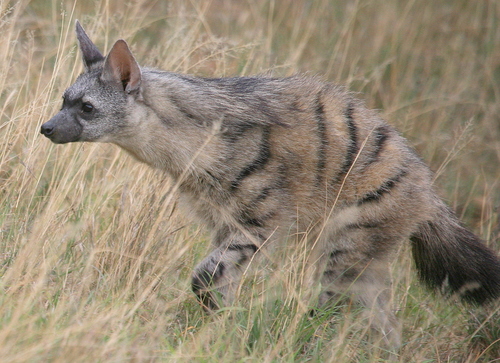
Southern Aardwolf
Proteles cristatus
A gentle, termite-loving relative of the hyena, the Southern Aardwolf is one of Africa’s most misunderstood and elusive nocturnal treasures. With its striking striped coat and impressive mane, seeing one on your camera is a true highlight for any backyard safari.
Quick Identification
Size
55-80 cm (22-31 in) long; 40-50 cm (16-20 in) shoulder height; 7-10 kg (15-22 lbs)
Colors
Buff or yellowish-white coat with vertical black stripes; black mane along the spine; bushy tail with a black tip; dark muzzle
Key Features
- Vertical black stripes on a pale yellowish coat
- Long, erectile mane along the back and neck
- Sloping posture with front legs longer than back legs
- Slender, fox-like muzzle and large pointed ears
When You’ll See Them
Behavior
The Southern Aardwolf is a shy, solitary member of the hyena family that has traded bone-crushing jaws for a specialized diet of termites. Unlike their larger, more aggressive cousins, aardwolves are timid and spend their days tucked away in underground burrows, emerging only under the cover of darkness to forage. They are territorial and live in monogamous pairs, though they usually forage alone to maximize their efficiency in finding termite patches across their home range.
While they may look like a miniature striped hyena, their temperament is far more docile. When threatened, they rely on a remarkable defense mechanism: raising their long dorsal mane to appear twice their actual size and emitting a foul-smelling musk from their anal glands. To the casual observer or a trail camera enthusiast, they are a fascinating example of specialized evolution, moving with a characteristic 'sloping' gait as they sniff the ground for their next meal.
EverydayEarth exclusive
Camera Tips
Capturing a Southern Aardwolf on camera requires a strategic approach focused on their specific foraging habits. Unlike most predators, the aardwolf cannot be lured with meat or standard baits; instead, you must find where their food is. Look for areas with high concentrations of termite mounds, particularly those of the Trinervitermes genus. Position your camera along well-worn footpaths leading away from known burrows or near 'middens'—communal dung heaps that aardwolves use to mark their territory. These locations are high-traffic zones where the animals are likely to pause, giving you the perfect shot.
Placement is critical for this species. Because they are relatively low to the ground, set your camera at a height of about 12 to 18 inches (30-45 cm). Angle the lens slightly upward if you are on a slope to capture their impressive mane. Use a 'no-glow' or black infrared flash; aardwolves are incredibly skittish and a traditional red-glow flash or white flash may spook them, causing them to abandon the area for several nights. Ensure your trigger speed is set to the fastest possible setting, as they can move surprisingly quickly when navigating between feeding sites.
If you are monitoring a large property, consider the season. In the colder winter months, aardwolves may shift their activity to the late afternoon or early evening (crepuscular) to take advantage of the remaining warmth, while in summer, they are strictly nocturnal. Setting your camera to 'Multi-Shot' or 'Burst' mode is highly recommended. This allows you to see the aardwolf in action as it licks termites off the soil surface, providing a much more dynamic look at their behavior than a single static image.
Similar Species
Species that look similar or are commonly confused with Southern Aardwolf.
Frequently Asked Questions
Record Southern Aardwolf at your habitat
Connect a camera to start building your own species record — AI identifies every visitor automatically.