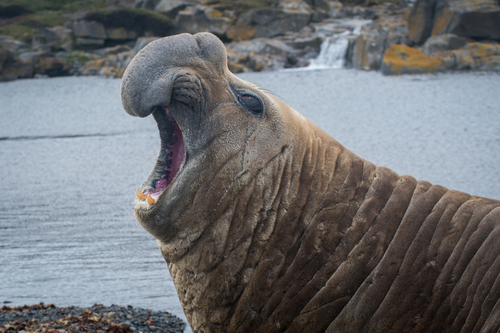
Southern Elephant Seal
Mirounga leonina
Witness the sheer power of the ocean's largest seal. From thunderous beach battles to record-breaking deep-sea dives, the Southern Elephant Seal is a true titan of the Antarctic wild.
Quick Identification
Size
Males: 4.5–5.8m (15–19ft) / 2,200–4,000kg (4,850–8,800lbs). Females: 2.6–3m (8.5–10ft) / 400–900kg (880–2,000lbs).
Colors
Adults range from slate gray to rusty brown. Pups are born with black fur (lanugo). Mature males often have scarred, pinkish-brown chests.
Key Features
- Massive inflatable proboscis (trunk) on adult males
- Significant sexual dimorphism with males being 5-6 times heavier than females
- Large, dark eyes designed for low-light deep-sea hunting
When You’ll See Them
Behavior
Southern Elephant Seals are the undisputed heavyweights of the pinniped world, spending up to 80% of their lives at sea. They are world-record divers, capable of plunging to depths of over 2,000 meters and holding their breath for more than two hours while hunting for squid. When they return to land to breed or molt, they become surprisingly social, though these gatherings are often loud and chaotic. Adult males, or 'beachmasters,' engage in thunderous vocalizations and violent physical battles to maintain harems of dozens of females.
Despite their lumbering appearance on land, they are highly efficient and aggressive when defending territory. While they generally ignore humans if a respectful distance is kept, they can move surprisingly fast in short bursts over sand. Their annual molt is a unique 'catastrophic' event where they shed not just their fur, but the entire upper layer of their skin in large patches, during which they remain beach-bound and look somewhat ragged.
EverydayEarth exclusive
Camera Tips
Capturing the Southern Elephant Seal requires specialized preparation due to their massive size and harsh coastal environments. To fit a 4,000kg bull in the frame, you should use a wide-angle lens and place your camera at least 15–20 feet back from the 'haul-out' line. If you are using a trail camera, mount it on a sturdy, salt-resistant post rather than a tripod, as a curious seal can easily knock over or even crush lightweight equipment. Angle the camera slightly downward from a higher vantage point to capture the scale of the colony without being obscured by the tall grasses or uneven sand dunes common in their habitat.
Exposure settings are critical because the bright Southern Ocean sun reflecting off white sand or surf can easily blow out the highlights on a seal's wet skin. If your camera allows, set a negative exposure compensation (-1.0 or -2.0) during midday hours. Since these seals are most vocal and active during the early morning and late evening, ensure your camera has excellent low-light performance or high-quality IR flash. Trigger speeds should be set to 'High' to capture the fast-paced lunges of battling bulls, which can happen with little warning.
Because the salt spray and sandy grit of sub-antarctic beaches are highly corrosive, always use a protective weatherproof housing and wipe the lens daily with a microfiber cloth. Avoid using any food-based lures, as these are wild animals in protected zones and baiting is often illegal and dangerous. Instead, focus your camera on natural 'paths'—the drag marks in the sand where seals transition from the water to the dunes. During the molting season, look for damp, muddy depressions where they huddle together to stay warm; these are prime spots for time-lapse photography.
Similar Species
Species that look similar or are commonly confused with Southern Elephant Seal.
Northern Elephant Seal
Found in the Northern Hemisphere; males have a longer, more pendulous trunk and are slightly smaller overall.
Leopard Seal
Much more slender and serpent-like with a spotted coat and massive jaws; lacks the inflatable nose of the elephant seal.
Weddell Seal
Smaller with a cat-like face and short muzzle; usually found further south on the actual Antarctic ice shelf.
Frequently Asked Questions
Record Southern Elephant Seal at your habitat
Connect a camera to start building your own species record — AI identifies every visitor automatically.